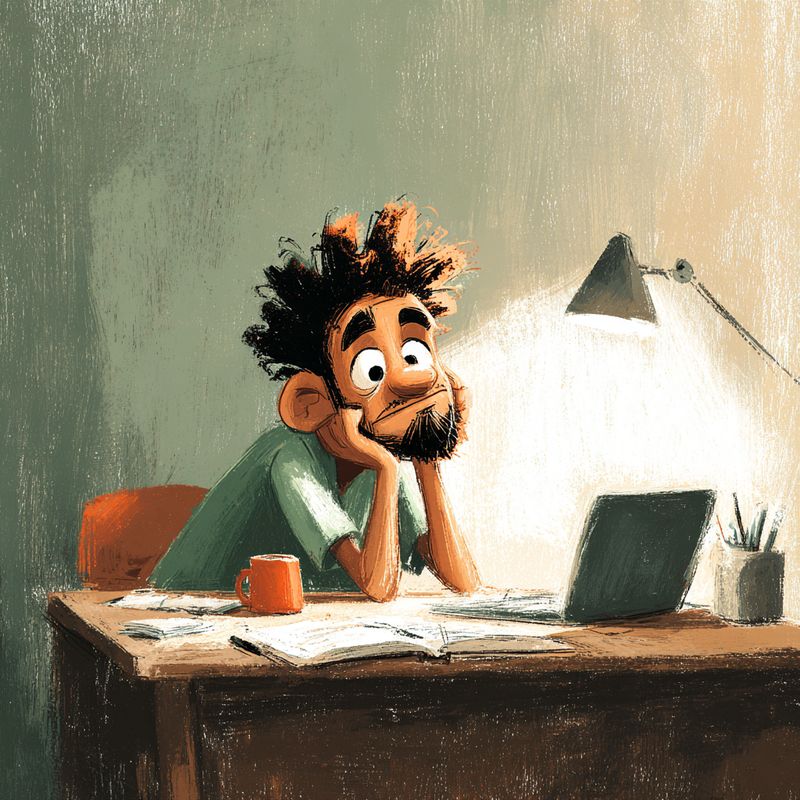
Your inner critic doesn’t announce itself. It doesn’t say “I’m afraid.” It says “this isn’t ready yet.”
That’s the trap. Self doubt in creative work rarely shows up as obvious insecurity. It shows up dressed in the language of craft: not polished enough, not researched enough, not worthy of an audience yet. For creative professionals, this disguise is so convincing that most people never question it. Research consistently shows that perfectionism and procrastination are deeply linked, and that the voice urging endless revision is often fear, not conscientiousness. Recognizing the difference is what separates work that exists from work that lives permanently in drafts.
Why Does Self-Doubt Sound So Much Like a High Standard?
Self doubt stops creation by borrowing the vocabulary of quality. The inner critic in creative work doesn’t say “you’ll be judged and found lacking.” It says “a truly dedicated professional would get this right before sharing it.” The result is identical: nothing gets shipped. But the feeling is completely different, closer to diligence than dread.
This is the core paradox that traps creative professionals. The internal experience of perfectionism-as-procrastination feels like responsibility. It feels like you’re protecting your audience from substandard work. In reality, you’re protecting yourself from exposure.
In her 2010 book The Gifts of Imperfection, researcher Brené Brown draws a clear line between the two:
“Perfectionism is not the same thing as striving to be our best. Perfectionism is the belief that if we live perfect, look perfect, and act perfect, we can minimize or eliminate the painful experiences of shame, judgment, and blame.”
That distinction matters enormously. Striving for excellence is outward-facing: it’s about the work and the audience. Perfectionism is inward-facing: it’s about avoiding pain. When your inner critic is running the show, every delay, every revision, every “I’ll release it when it’s ready” is a self-protection strategy wearing craft’s clothing.
What Does the Research Actually Say About Perfectionism and Procrastination?
Perfectionism as procrastination isn’t a metaphor. The connection is measurable, documented, and surprisingly strong. Research by Flett and Hewitt, published in 2002, found that perfectionists are two to three times more likely to experience chronic procrastination compared to non-perfectionists. That’s not a personality quirk. That’s a systematic pattern.
A 2007 meta-analysis by Piers Steel, published in Psychological Bulletin, found that approximately 25% of the population experiences chronic procrastination, with perfectionism identified as a significant underlying factor. For creative professionals, who exist in fields defined by subjective judgment and public visibility, those numbers almost certainly skew higher.
The neuroscience adds another layer. In his 2016 book Idiot Brain, neuroscientist Dean Burnett explains that the brain’s default mode network, often described as the “inner critic,” evolved to protect us from social rejection and danger. In modern creative work, that same system manifests as perfectionism and self-doubt rather than responses to actual threats. Your brain is running ancient threat-detection software on a 21st-century creative problem. It can’t tell the difference between a predator and a one-star review.
The practical consequence: every time your inner critic tells you the work isn’t ready, it’s triggering the same neurological circuitry that would fire if you were genuinely in danger. The fear is real. The threat is not.
How Does Imposter Syndrome Connect to This Pattern?
Imposter syndrome in artists and creative professionals adds a second layer to this dynamic. Where perfectionism says “the work isn’t good enough,” imposter syndrome says “you aren’t good enough to be making this work at all.” Together, they’re extraordinarily effective at keeping creative output off the table.
Research from Langford and Clance, published in 1993, found that 70% of adults report experiencing imposter syndrome at some point in their lives, with notably higher rates among high-achieving individuals and creative professionals specifically. The more skilled you become, paradoxically, the more sophisticated your self-doubt becomes. It scales with your awareness.
This is the contrarian point worth sitting with: expertise doesn’t cure imposter syndrome. It often intensifies it. A beginner doesn’t know enough to fully catalog their own inadequacies. An experienced creative professional knows exactly what great work looks like, which gives their inner critic much more specific ammunition.
Brené Brown addresses the shame mechanism directly in her 2018 book Dare to Lead:
“You cannot shame or belittle people into changing their behaviors… shame is highly correlated with addiction, violence, aggression, depression, eating disorders, and suicide.”
She’s describing external shame, but the same principle applies internally. Berating yourself into producing better work doesn’t work. The inner critic, for all its confidence, is not a reliable creative director.
What’s the Real Cost of Waiting Until It’s Perfect?
The cost isn’t just delayed output. It’s the permanent non-existence of work that had genuine value. Perfect work that remains imaginary helps no one. Imperfect work that exists can be read, heard, seen, iterated on, and built upon.
Adam Grant makes a nuanced point in his 2016 book Originals that’s easy to misread:
“Procrastination may be the enemy of productivity, but it can be a resource for creativity.”
Grant’s research suggests that some delay can allow ideas to develop. But there’s a critical difference between strategic incubation and indefinite avoidance. The former serves the work. The latter serves the fear. Knowing which one you’re doing requires honesty that most perfectionism-driven creators actively avoid.
Grant also notes in Originals that the things creators are most afraid to do are often the things most likely to improve the quality of their creative lives. The work you’re most resistant to releasing is frequently the work that matters most, not because it’s unfinished, but because it’s personal enough to feel risky.
That risk-aversion has a practical price. Every month a project stays in revision is a month it isn’t building an audience, generating feedback, or creating opportunities. The imaginary perfect version isn’t competing with your imperfect real version. It’s replacing it entirely.
How Can Creative Professionals Recognize the Disguise in Real Time?
Recognizing the disguise is the first and most actionable step. The inner critic in creative work is skilled at mimicry, but it has tells. Three questions cut through the performance reliably.
First: Is this revision serving the audience or protecting you? If you can articulate a specific improvement that makes the work clearer or more useful to the person receiving it, that’s craft. If the revision is about removing anything that could be criticized, that’s self-protection.
Second: Has the standard shifted since you started? Self doubt stopping creation often operates by moving the goalposts. The work reaches the original benchmark, and suddenly the benchmark changes. Noticing this pattern in real time breaks its power.
Third: Would a version of you who wasn’t afraid release this? This question separates quality concerns from courage concerns. Sometimes the answer is genuinely no, and the work needs more. But often the answer is yes, and that’s information worth acting on.
Brown’s framework from The Gifts of Imperfection is also useful here. She notes that perfectionism is self-destructive because there is no such thing as perfect, and “perfection is an unattainable goal.” Framing the delay as self-destructive rather than professional reframes the whole equation. You’re not being rigorous. You’re burning time on a target that doesn’t exist.
Time tracking tools that make invisible delay visible can be useful here. When you can see how many hours have gone into revision cycles on a single project, the “not ready yet” story becomes harder to sustain uncritically.
FAQ
Is perfectionism always self-doubt in disguise, or are high standards sometimes legitimate?
High standards and perfectionism are genuinely different things. High standards are specific, achievable, and outward-focused: the work meets a defined quality threshold that serves the audience. Perfectionism is indefinite and inward-focused, rooted in avoiding shame rather than serving quality. The clearest distinction is whether the standard can actually be met. If it keeps shifting, it’s self doubt creative work has borrowed the language of craft to justify.
Why do creative professionals seem to experience imposter syndrome at higher rates?
Creative fields involve constant public judgment on subjective work, which makes the gap between internal experience and external perception unusually wide. Research from Langford and Clance (1993) found imposter syndrome rates are higher among high-achieving individuals precisely because greater expertise means greater awareness of what excellent work looks like, giving the inner critic more specific material to work with. Skill and self-doubt often grow together.
How is perfectionism as procrastination different from ordinary laziness?
They feel completely different from the inside, and the research treats them as distinct phenomena. Ordinary procrastination often involves choosing easier tasks over harder ones. Perfectionism as procrastination frequently involves enormous effort, just directed at endless refinement rather than completion and release. Perfectionists aren’t avoiding work. They’re avoiding the exposure that comes with finished work existing in the world.
Does releasing imperfect work actually damage a creative professional’s reputation?
The evidence suggests the fear is disproportionate to the actual risk. Research on creative output consistently finds that volume and iteration produce better long-term results than prolonged single-project perfectionism. Work that exists and is seen generates feedback that improves future work. Work that stays in drafts generates nothing. The reputation risk of releasing something imperfect is generally far smaller than the opportunity cost of not releasing it.
What’s the fastest way to distinguish between the inner critic and genuine quality concerns?
Ask whether you can articulate the specific improvement in concrete, audience-serving terms. “This section is unclear to a reader who hasn’t read the previous chapter” is a genuine quality concern. “This just doesn’t feel right yet” is almost always the inner critic speaking. The inner critic in creative work tends to be vague, absolute, and immune to being satisfied. Genuine quality concerns are specific, addressable, and resolvable.