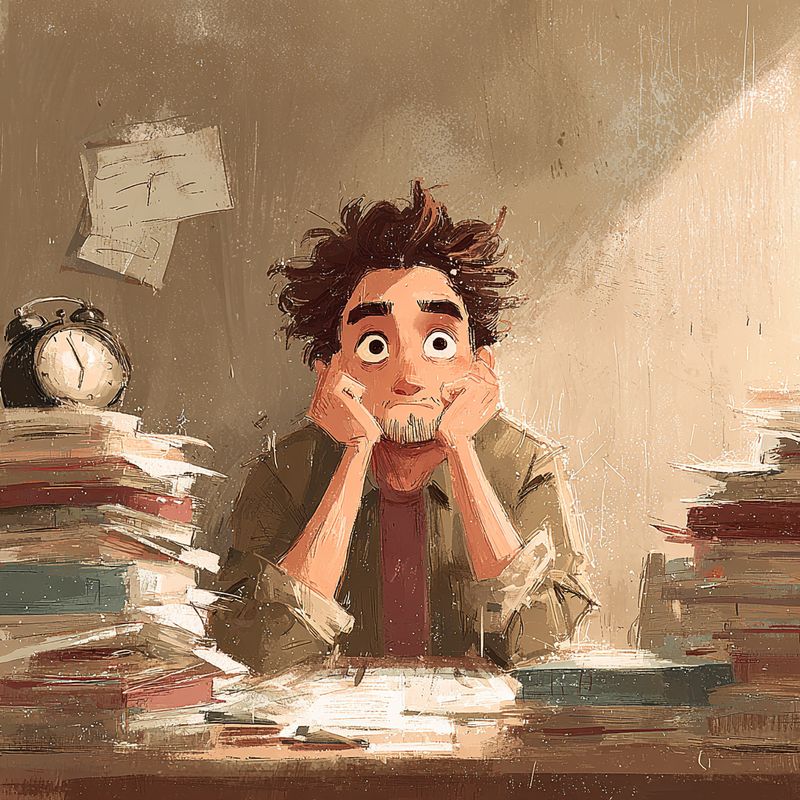
Procrastination on decisions isn’t about being lazy or disorganized. It’s about feelings. When a big life decision triggers anxiety, your brain does the only logical thing it knows: it runs. Understanding why that happens is the first step to actually stopping it.
Research consistently shows that procrastination on major life choices is an emotion regulation strategy, not a productivity failure. According to research by organizational psychologist Adam Grant, we procrastinate to avoid the negative emotions a task stirs up, not because we lack motivation. For big decisions, those emotions are often fear, uncertainty, and the creeping dread of getting it wrong. Approximately 95% of people procrastinate to some degree, according to research by Fuschia Sirois and Timothy Pychyl, and decision paralysis affects roughly 40% of major life decisions, with people delaying choices for months or even years (meta-analysis, 2015–2020).
The good news? Once you understand the emotional engine driving avoidance, you can work with it instead of against it.
Why Do Big Life Decisions Trigger Procrastination?
Big decisions feel different from small ones because the stakes feel permanent. Choosing a career path, ending a relationship, or deciding whether to have children doesn’t come with an undo button. That sense of irreversibility activates threat responses in the brain, and avoidance becomes the path of least resistance.
Neuroscientist Dean Burnett, in his 2016 book Idiot Brain, explains that the brain’s reward system is strongly biased toward immediate gratification, making future consequences feel abstract and less motivating than present discomfort. In plain terms: the relief you feel by not deciding today is real and immediate, while the cost of not deciding feels distant and theoretical. Your brain takes the deal every time.
This is why avoiding big decisions feels rational in the moment. It isn’t avoidance of the decision itself. It’s avoidance of the anxiety the decision produces.
Sirois and Pychyl’s 2013 research, published in their work Procrastination and the Priority of Short-Term Mood Regulation, found that people who procrastinate on decisions consistently report higher anxiety and lower life satisfaction scores than those who don’t. The short-term emotional relief comes at a long-term cost.
Is Decision Paralysis Actually an Emotional Habit Loop?
The pattern of avoiding big decisions isn’t random. It follows a predictable structure that neuroscience researcher Judson Brewer has spent years studying at Brown University.
In The Craving Mind (2017) and his Brown University mindfulness research, Brewer describes procrastination as a habit loop: we use it as a way to regulate our emotions in the moment, even though we know it will make us feel worse later.
The loop works like this. A big decision triggers discomfort. You distract yourself, postpone the decision, or bury it under busywork. The discomfort eases temporarily. Your brain registers: avoidance works. So the next time a similarly uncomfortable decision appears, the loop fires automatically.
This is why life choices procrastination feels so sticky. It isn’t a bad habit you formed by accident. It’s a reward system your brain has carefully reinforced over time.
Chronically, this adds up. Research by Piers Steel, published in Psychological Bulletin in 2007, found that 20 to 25% of the adult population identifies as chronic procrastinators, many of whom report that major life decisions are their primary sticking point. The habit loop isn’t a quirk. For millions of people, it’s a defining pattern.
What Makes Some Life Decisions Harder to Make Than Others?
Not all decisions create equal paralysis. Three specific conditions tend to make life choices procrastination worse.
High personal identity stakes. Decisions that feel like they define who you are, such as career changes, relationship commitments, or where to live, carry identity weight that purely practical decisions don’t. Getting them wrong feels like proof of something unflattering about yourself.
Too many options. Decision psychology research consistently shows that more options increase anxiety rather than reducing it. When every path seems viable, the fear of choosing the slightly-less-optimal one keeps people frozen.
Ambiguous timelines. Decisions with no external deadline are the most commonly avoided. If there’s no consequence for waiting until next month, next month becomes next year becomes never.
Understanding which of these conditions is driving your specific paralysis matters. Treating an identity-stakes decision the same way you’d treat an options-overload decision won’t work.
Can Waiting to Decide Ever Be the Right Call?
Here’s the contrarian take most productivity advice ignores: sometimes, procrastination on decisions is exactly right.
Adam Grant, in various interviews and TED talks on productive procrastination, has noted that some procrastination is genuinely useful. Waiting to decide can give you time to gather more information and consider alternatives you wouldn’t have thought of immediately. The key word is waiting, not avoiding.
The distinction matters. Productive delay means you’re actively gathering information, sitting with uncertainty, and allowing subconscious processing to happen. Avoidance means you’re not thinking about the decision at all because thinking about it feels bad.
Research on incubation in decision-making supports Grant’s point. Allowing time between initial consideration and final choice often produces better outcomes, particularly for complex decisions with many variables. The problem isn’t waiting. It’s the emotional static that turns waiting into indefinite postponement.
A practical test: if you can articulate what additional information would help you decide, you’re in productive waiting territory. If you genuinely can’t say what’s stopping you, that’s avoidance dressed up as deliberation.
How Can Mindfulness Actually Help You Decide Faster?
Mindfulness gets mentioned so often in mental health contexts that it can start to sound like a vague platitude. But Brewer’s Brown University research gives it a specific and practical mechanism when it comes to decision paralysis.
As Brewer explains in The Craving Mind (2017), mindfulness can break the procrastination habit loop by increasing awareness of the urge to procrastinate without judgment, allowing people to make conscious choices rather than automatic ones.
The operative word is awareness. Most people who avoid big decisions don’t consciously think: “I’m going to delay this because it makes me anxious.” The avoidance happens automatically, before conscious deliberation kicks in. Mindfulness interrupts that automaticity by making the emotional trigger visible.
In practice, this looks less like meditation and more like a brief check-in when you notice yourself postponing a decision. Ask: what am I actually feeling right now? Is this discomfort coming from genuine uncertainty, or am I just uncomfortable with the act of deciding? That 30-second pause can interrupt the habit loop before it completes.
Brewer’s research with Brown University also found that curiosity is one of the most effective mindfulness tools. Approaching the discomfort of a difficult decision with curiosity rather than aversion changes its emotional charge. It transforms anxiety into information.
How to Make Faster Decisions Without Ignoring Your Emotions
The goal isn’t to suppress the emotions that make big decisions hard. It’s to stop letting those emotions run the process entirely.
A few evidence-backed approaches that work with the emotional grain rather than against it:
Name the emotion specifically. Research in affective labeling, developed through UCLA neuroscience work, shows that naming an emotion precisely reduces its intensity. “I’m afraid I’ll regret this” is more workable than a vague sense of dread.
Set a decision deadline, then work backward. Because ambiguous timelines are one of the primary drivers of life choices procrastination, creating an artificial deadline with a real consequence removes one of the key conditions for avoidance. Tell someone the date. Write it somewhere visible.
Use a two-column regret test. Instead of asking which choice is better, ask: in ten years, which choice am I more likely to regret not making? Jeff Bezos popularized this framing, and decision psychology supports it. Future regret is a more emotionally tractable question than abstract optimization.
Accept imperfect information as the normal condition. One of the most persistent myths about big decisions is that there’s a point at which you’ll have enough information to decide confidently. There usually isn’t. Research on decision-making under uncertainty consistently shows that waiting for certainty is itself a decision, and rarely a neutral one.
Faster decisions don’t require emotional shutdown. They require emotional clarity.
FAQ
Q: Is procrastination on decisions the same as indecisiveness? A: Not exactly. Indecisiveness tends to be a trait-level difficulty with making choices in general. Decision procrastination is more situation-specific and driven by the emotional weight of a particular choice. Someone can be decisively low-stakes and completely paralyzed on high-stakes decisions.
Q: How long is too long to sit with a major life decision? A: There’s no universal timeline, but a useful benchmark comes from decision psychology research: if additional time is giving you new information or genuine perspective, it’s productive. If you’ve been in the same mental loop for weeks without forward movement, that’s avoidance. The content of the delay matters more than its length.
Q: Can anxiety medication or therapy help with decision paralysis? A: For people whose decision avoidance is tied to clinical anxiety, yes, addressing the underlying anxiety directly can reduce paralysis significantly. Cognitive behavioral therapy has a strong evidence base for both anxiety and procrastination. A GP or mental health professional is the right starting point if the pattern is severe or pervasive.
Q: Why do I procrastinate on good decisions as well as difficult ones? A: Because the brain responds to uncertainty, not valence. A good decision that’s uncertain, say, accepting a promising job offer or starting a relationship, still activates threat responses if the outcome feels unpredictable. The anxiety isn’t always about whether the choice is good or bad. It’s about the loss of control that committing to any path involves.
Q: Does procrastination on big decisions get worse with age? A: Research on this is mixed. Older adults tend to have more practiced decision-making heuristics, which can help. But they also accumulate more to lose, which can intensify avoidance on high-stakes choices. The emotional root of the habit loop doesn’t disappear with age unless it’s actively addressed.