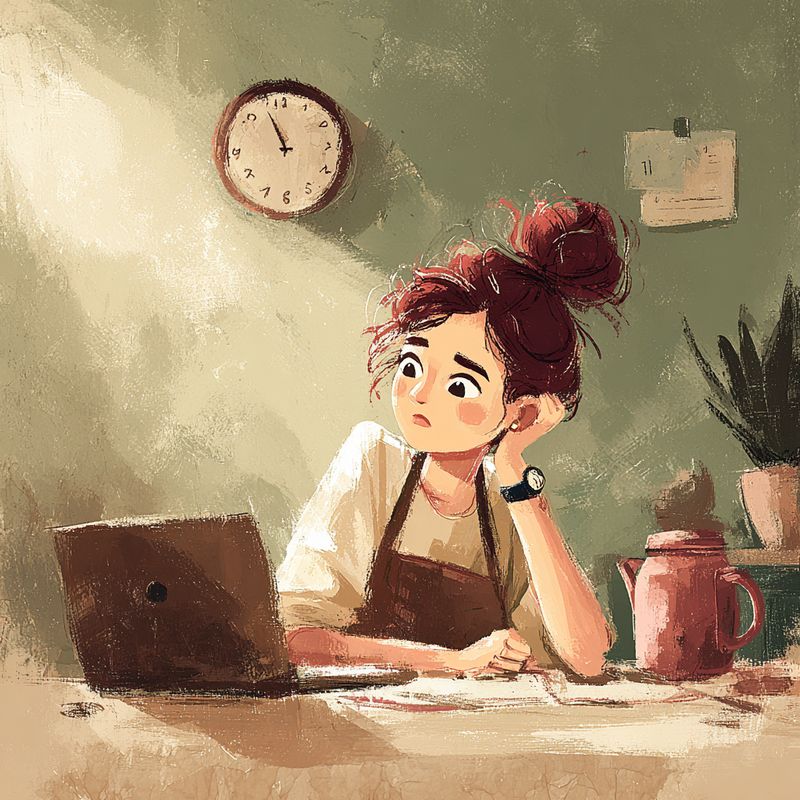
Most high school students who cram the night before an exam don’t do it because they’re lazy, disorganised, or don’t care. They do it because their brain is doing exactly what brains are designed to do: protect them from discomfort right now, even at the cost of pain later.
That’s not a character flaw. That’s neuroscience.
Understanding why last minute cramming happens, and why willpower-based advice (just start earlier, set a timer, make a schedule) so reliably fails, is the first step to actually breaking the cycle. So here’s what the research says.
Is procrastination really just a time management problem?
No. And this reframing matters more than it might seem. Procrastination isn’t primarily about poor planning or not knowing when your exam is. It’s about how your brain responds to emotional discomfort. Once you understand that, all those productivity hacks that focus purely on scheduling start to make a lot more sense as to why they don’t stick.
Organisational psychologist Adam Grant, drawing on research from Wharton, has argued that procrastination is fundamentally an emotion regulation problem rather than a productivity problem. The idea: we procrastinate to feel better in the moment, even when we know it will make us feel worse later.
That’s a significant shift in how most people think about exam stress and homework avoidance. It means the enemy isn’t laziness. It’s the brain’s very efficient system for avoiding negative feelings.
Research backs this up. A 2016 meta-analysis from the Procrastination Research Lab at Carleton University, led by Timothy Pychyl and Fuschia Sirois, found that approximately 50% of university students engage in procrastination regularly. An earlier survey published by Schouwenburg and colleagues in 2004 put that figure even higher, with 75% of college students identifying themselves as procrastinators.
Those numbers are too high to be explained by a shortage of good planners. Something else is going on.
What actually happens in your brain when you avoid studying?
When you sit down to revise for an exam and feel that familiar wave of dread, boredom, or anxiety, your brain registers studying as a threat. Not a physical threat, but an emotional one. And the brain’s response to emotional threat is well-practised: get away from it.
Neuroscientist and science communicator Dean Burnett explains this clearly in his 2016 book Idiot Brain. The brain’s reward system is heavily biased toward immediate gratification. When a deadline feels distant, the procrastinating brain treats the discomfort of studying now as a bigger and more urgent problem than the stress of scrambling to do it later.
Burnett has also written for BBC Science Focus that procrastination isn’t laziness at all. It’s the brain protecting itself from the negative emotions associated with a task.
This is why test preparation so often gets pushed back day after day. Each time you choose to scroll your phone instead of opening your notes, your brain gets a small hit of relief. That relief is real. It’s immediate. And it reinforces the avoidance behaviour, making it more likely you’ll do the same thing tomorrow.
Jonathan Schooler, whose research on attention has been published in journals including Consciousness and Cognition and Psychological Bulletin, adds another layer to this. His work suggests that mind-wandering, the kind where you’re technically sitting at your desk but mentally somewhere else entirely, can function as a form of emotion avoidance. Procrastinators may engage in excessive mind-wandering not because they’re unfocused, but because their brain is actively steering away from the discomfort of the task in front of them.
So you’re not daydreaming because you’re undisciplined. Your brain is doing its job. Just not the job you need it to do right now.
Why does last minute cramming feel like it works?
Here’s the part that makes the cycle so hard to break: cramming often does produce results, at least in the short term. You sit down at 11pm the night before your biology exam, panic-read your notes for three hours, and somehow scrape a passing grade. Your brain logs that as a success.
But the evidence on what’s actually happening to your learning tells a different story.
Research published in Psychological Science in the Public Interest by Dunlosky and colleagues in 2013 found that last-minute studying reduces information retention by up to 50% compared to distributed study sessions spread over time. You’re absorbing less, remembering less, and building less actual understanding, even if the grade doesn’t always reflect that immediately.
A study by Tice and Baumeister published in 1997 found that students who procrastinate score approximately 5 to 10% lower on exams than their non-procrastinating peers. That gap compounds over time across multiple subjects and assessments.
And the stress cost is significant. Research by Lay and colleagues published in 1989 found that procrastinators experience higher levels of stress and anxiety related to academic work than non-procrastinators. The irony is real: homework avoidance is driven by a desire to feel better, but the procrastination cycle consistently produces more stress overall, not less.
Why doesn’t “just start earlier” actually work?
Because willpower is not a reliable solution to an emotion regulation problem.
Telling a student who’s avoiding revision to “just sit down and do it” is a bit like telling someone with a fear of heights to “just climb the ladder.” The advice isn’t technically wrong. It just ignores the mechanism driving the behaviour.
When the core issue is that studying triggers negative emotions, and the brain has been reinforced over time to escape those emotions through avoidance, pushing through on willpower alone tends to work exactly once before the system resets.
Adam Grant’s research also highlights an interesting flip side worth knowing about. He refers to “pre-crastination,” the tendency to start tasks too early, sometimes impulsively and without a real plan, as potentially just as problematic as procrastination. The point isn’t to replace one extreme with another. It’s to develop a more intentional relationship with how you approach tasks.
Strategies that address the emotional side of procrastination tend to be more durable than schedule-based fixes alone. These include:
- Breaking tasks into smaller steps that feel less threatening to start
- Acknowledging the discomfort directly rather than fighting it (researchers call this “affect labelling”)
- Using implementation intentions: specific “when X happens, I will do Y” plans that reduce the decision-making load in the moment
- Treating self-compassion as a study skill, because research consistently shows that students who respond to procrastination with harsh self-criticism are more likely to procrastinate again, not less
How can understanding this actually help with exam stress?
Knowing the mechanism behind procrastination doesn’t automatically fix it. But it does change what you’re trying to fix, and that shift matters.
If you’ve been treating last minute cramming as a discipline problem, you’ve probably been trying solutions aimed at the wrong target. You’ve set alarms you’ve ignored, made colour-coded schedules you’ve abandoned, and told yourself you’ll start properly next time.
Re-framing procrastination as an emotion regulation challenge opens up more effective options. The goal isn’t to manufacture motivation from nowhere. It’s to reduce the emotional friction that makes starting feel so difficult in the first place.
Practically, that might look like starting with the easiest part of a topic rather than the hardest, so the brain gets early evidence that studying isn’t as threatening as predicted. It might mean studying for 10 minutes with no pressure to continue, building a low-stakes on-ramp. Or it might mean noticing the urge to switch to your phone and pausing for a moment before acting on it, not to white-knuckle through it, but to give the rational part of your brain a chance to catch up.
The research is clear that distributed practice beats last minute cramming for retention. The challenge is creating conditions where starting early feels emotionally possible, not just logically obvious.
That’s the cycle worth breaking. And understanding your brain is where it starts.
FAQ
Is procrastination a sign of laziness?
No. Research consistently shows that procrastination is driven by emotion regulation, not laziness or low effort. According to work popularised by organisational psychologist Adam Grant and supported by neuroscience communicators like Dean Burnett, the brain avoids tasks that trigger negative emotions. That’s a functional response, not a character flaw.
Why does last minute cramming feel effective even when it isn’t?
Cramming can produce short-term results, which reinforces the behaviour. But a 2013 study by Dunlosky and colleagues in Psychological Science in the Public Interest found that last-minute studying reduces long-term retention by up to 50% compared to spaced practice. The grade might be okay. The learning is significantly shallower.
How common is procrastination among students?
Very. A 2016 meta-analysis from Carleton University’s Procrastination Research Lab found approximately 50% of university students procrastinate regularly. A 2004 survey by Schouwenburg and colleagues found 75% of college students self-identify as procrastinators. It’s one of the most widespread challenges in academic settings.
Why don’t productivity tips fix procrastination?
Most productivity advice targets time management rather than emotional avoidance. Because procrastination is rooted in how the brain responds to discomfort, strategies that only address scheduling (set a timer, break tasks into steps) tend to fail unless they also reduce the emotional friction that causes avoidance in the first place.
Does procrastinating make exam stress worse overall?
Yes. Research by Lay and colleagues published in 1989 found that procrastinators experience higher levels of stress and anxiety around academic work than non-procrastinators. The avoidance that’s meant to provide short-term relief tends to generate more overall stress across the course of a term, not less.