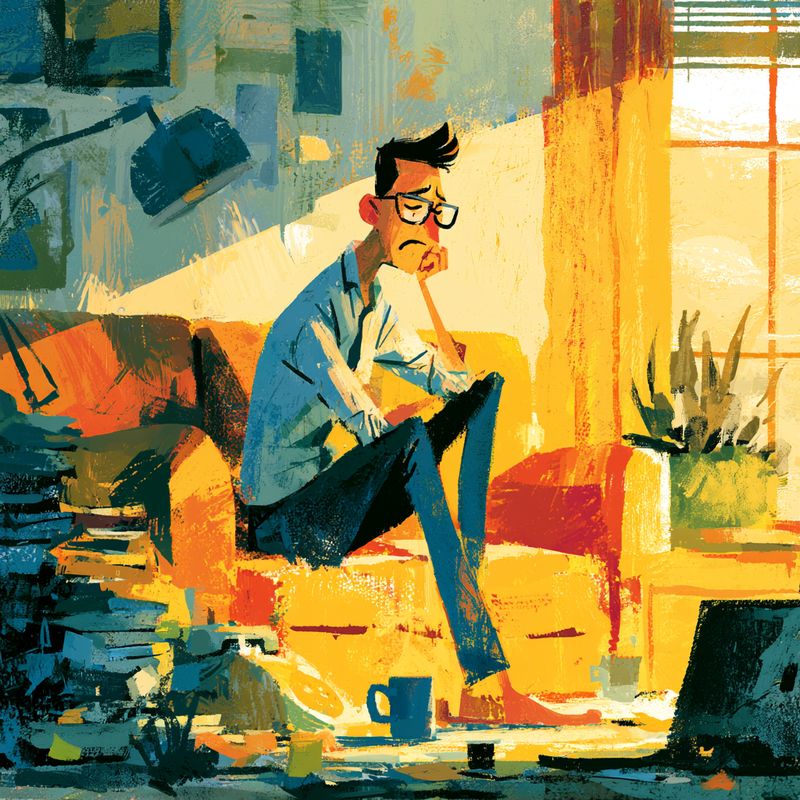
The reason you feel worse after procrastinating isn’t weakness or laziness. It’s your brain running a faulty emotional bargain it can never actually win.
When you avoid a stressful task, your brain gets a brief hit of relief. But the task doesn’t disappear. It stays loaded in your mental background, quietly burning cognitive fuel and generating a slow drip of anxiety and guilt that compounds over time. Understanding why this happens changes how you think about procrastination entirely.
Why doesn’t procrastination make you feel better?
Most people expect avoidance to bring relief. And it does, for a moment. The problem is that the relief is real but shallow, and what replaces it is worse than the original discomfort.
Researchers Tice and Baumeister tracked students across an academic semester and published their findings in Psychological Science in 1997. Students who procrastinated reported lower stress early in the semester, but by the end they showed significantly higher stress, more illness, and worse academic performance than their non-procrastinating peers. The short-term emotional payoff came with a long-term cost that far outweighed it.
This is the core paradox. Avoidance works well enough in the short run to reinforce itself, but never well enough to actually resolve the problem.
As neuroscientist Dean Burnett explains in his 2018 book The Happy Brain, the brain’s reward system creates this trap directly: avoiding an unpleasant task gives immediate relief, but this doesn’t resolve the underlying worry, which continues to generate background anxiety. The task is gone from your screen, but not from your nervous system.
What is actually happening in your brain when you procrastinate?
Procrastination isn’t a productivity failure. Research increasingly frames it as an emotion regulation failure, which reframes the whole conversation.
Psychiatrist and researcher Judson Brewer, whose work at Brown University examines habit formation and mindfulness, describes it this way: procrastination is an emotion regulation problem, not a productivity problem. We procrastinate to avoid negative emotions, but the avoidance itself creates more anxiety and guilt over time.
The mechanism Brewer identifies is a classic habit loop. A trigger arrives, usually emotional discomfort tied to a task: boredom, anxiety, self-doubt, or the fear of doing something badly. The behavior that follows is avoidance. The reward is temporary relief. But as Brewer’s Brown University research on habit formation shows, that reward is short-lived and the emotional discomfort returns, creating a self-reinforcing cycle.
Every time the loop completes, the brain learns that avoidance equals relief. The habit strengthens. The task grows heavier.
Approximately 20 to 25% of the adult population experiences chronic procrastination, according to a landmark 2007 meta-analysis by Piers Steel published in Psychological Bulletin. That’s not a small quirk. It’s a widespread pattern rooted in how emotional regulation and habit formation interact.
Why do I feel worse after procrastinating even when I’m distracted?
This is the question that catches most people off guard. You watched a show, you scrolled, you did something enjoyable. So why does the guilt still arrive?
The answer lies in what cognitive scientists call the “open loop.” An unfinished task doesn’t fully leave conscious awareness. It lingers as what psychologists sometimes call an intrusive thought: a background process that your brain keeps returning to, even when you’re not deliberately thinking about it.
Organizational psychologist Adam Grant, drawing on Wharton research on procrastination and motivation, puts it plainly: procrastination doesn’t eliminate the task. It just delays your emotional discomfort. The task remains on your mental to-do list, consuming cognitive resources even when you’re not consciously thinking about it.
This is why procrastination guilt feels so persistent. It doesn’t respect the distraction you’ve chosen. The brain keeps checking back on the unresolved stressor, interrupting enjoyment and generating low-level dread underneath whatever else you’re doing.
Research published in the International Journal of Emotional Education by Pychyl and Thibodeau in 2012 confirmed that procrastinators experience increased guilt and shame, which can intensify avoidance behaviors and worsen emotional distress. In other words, guilt about procrastinating makes procrastinating more likely. The trap tightens.
Is procrastination guilt actually useful information?
Here’s the contrarian take worth sitting with: the guilt isn’t the enemy. It’s a signal.
Procrastination guilt is your brain’s way of flagging that an open loop exists. It’s uncomfortable because it’s meant to be. The discomfort is functional, pointing toward something unresolved that your nervous system is tracking even when your conscious attention has moved elsewhere.
The problem isn’t that guilt exists. The problem is what people do with it. Most people respond to procrastination guilt by avoiding more, which intensifies the guilt, which increases the urge to avoid. The loop accelerates.
Understanding the neurobiology reframes the guilt usefully. It stops being evidence of moral failure (“I’m lazy, I’m broken, I have no willpower”) and becomes legible information (“My brain is flagging an unresolved stressor and running its avoidance routine”). That shift in interpretation is small but genuinely meaningful.
Willpower-based advice (just start, set a timer, try harder) fails people precisely because it treats procrastination as a discipline problem. If the root cause is emotion regulation, then forcing action without addressing the emotional trigger just adds more pressure to an already dysregulated system.
How does understanding this actually help you break the cycle?
Knowing the mechanism gives you somewhere to intervene that actually works.
The habit loop Brewer describes has three points: trigger, behavior, and reward. Most anti-procrastination advice targets the behavior, telling you to push through. But the more effective intervention targets the trigger: the emotional discomfort that starts the whole sequence.
This means asking a different question before you avoid. Not “why can’t I just do this” but “what does this task make me feel, and why?” The answer is often more specific than vague laziness. It might be fear of judgment, uncertainty about where to start, or the particular dread of a task that feels meaningless.
Naming the emotion reduces its intensity. This isn’t motivational advice; it’s basic neuroscience. The prefrontal cortex, responsible for rational processing, becomes more active when you label an emotional state, which reduces the amygdala’s threat response. The urge to flee softens slightly. Slightly is enough to create a gap between the trigger and the avoidance behavior.
Self-compassion also matters here in a concrete, non-fluffy way. Research consistently shows that people who respond to procrastination with self-criticism procrastinate more, not less. The guilt becomes another negative emotion to escape, adding fuel to the avoidance loop. Acknowledging that the avoidance made sense as an emotional strategy, without treating it as proof of personal failure, actually reduces its grip.
The goal isn’t to eliminate the discomfort associated with hard tasks. It’s to stop treating avoidance as a viable solution when the relief it offers is always temporary and the cost always compounds.
FAQ
Why do I feel worse after procrastinating if I was relaxing?
Because relaxation and resolution aren’t the same thing. Your brain tracks unfinished tasks as open loops, and those loops generate background anxiety regardless of what you’re doing in the foreground. The distraction doesn’t close the loop, so the underlying discomfort continues running beneath your enjoyment, which is why the guilt arrives even after an afternoon that should have felt restful.
Why does procrastinating make me feel bad when it used to feel fine?
The emotional cost of procrastination compounds over time. Early in a cycle, avoidance genuinely does provide relief because the deadline feels distant and the stakes feel abstract. As time passes, the unresolved task grows heavier, the deadline becomes concrete, and the accumulation of guilt and anxiety makes the relief shorter and the crash harder. What worked once stops working because the variables have changed.
Is procrastination guilt a sign of anxiety disorder?
Not necessarily. Procrastination guilt is a normal response to an unresolved stressor and the habit loop of avoidance. However, if procrastination and associated guilt are severely impacting your daily functioning, relationships, or mental health, that’s worth discussing with a professional. Chronic procrastination is associated with higher baseline anxiety and stress, according to Tice and Baumeister’s 1997 research in Psychological Science, so persistent patterns are worth taking seriously.
Why don’t I feel better after avoiding work even when the deadline is far away?
Because your brain doesn’t file tasks by deadline; it files them by resolution status. An unfinished task with a distant deadline still registers as an open loop. The relief from avoidance is real but temporary because the task hasn’t been completed or consciously deprioritized. It sits in working memory and keeps generating low-level threat signals, regardless of when it’s actually due.
What’s the most effective way to break the procrastination guilt cycle?
The most evidence-supported approach targets the emotional trigger rather than the behavior itself. Identifying the specific emotion a task generates (anxiety, boredom, self-doubt) and naming it explicitly reduces its intensity. Pairing that with self-compassion rather than self-criticism removes one layer of the avoidance loop. Brewer’s research at Brown University also supports curiosity-based awareness of the habit loop as an effective interruption technique. The goal is to make the discomfort legible rather than something to escape.