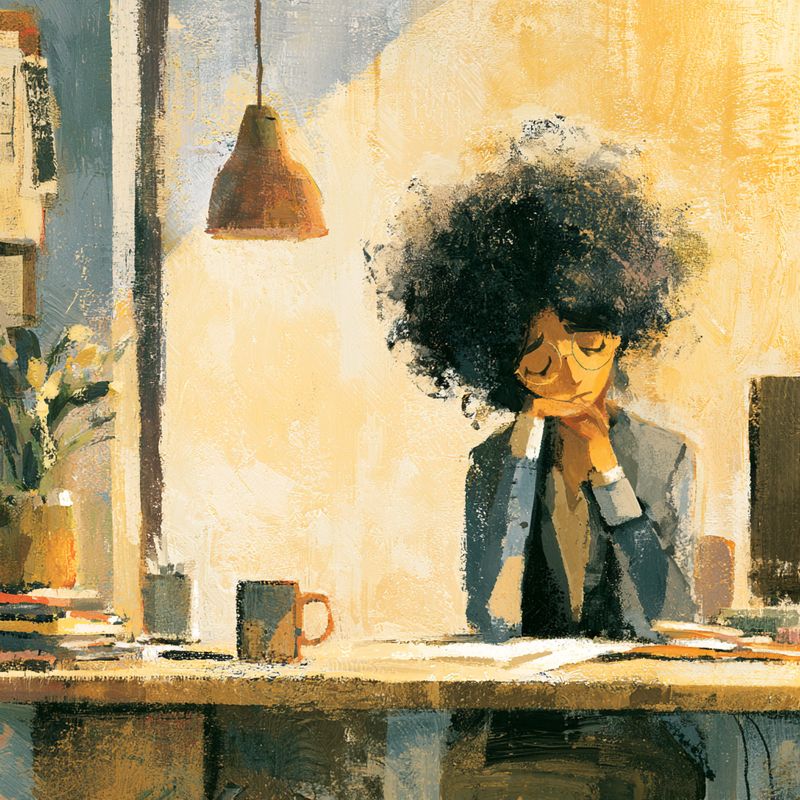
You put it off expecting to feel better. Instead, you feel worse. That’s not a character flaw. It’s a predictable psychological pattern that researchers have studied for decades, and understanding it is the first step to escaping it.
Procrastination doesn’t just delay tasks. It delays the emotional reckoning too, and when that reckoning arrives, it arrives with interest. The guilt after procrastinating, the creeping shame, the low-grade self-disgust: these aren’t random. They’re the direct result of how your brain handles the gap between what you intended to do and what you actually did.
Approximately 20% of adults identify as chronic procrastinators, according to a landmark 2007 meta-analysis by Piers Steel published in Psychological Bulletin. That’s one in five people regularly caught in this loop: avoid task, feel relief, feel worse, avoid again.
Why does procrastination feel good at first but bad afterward?
The initial relief is real. Your brain registers the removal of an uncomfortable task as a reward, flooding you with a brief sense of ease. But that ease has an expiration date measured in minutes, not hours.
As neuroscientist Dean Burnett explains in his book Idiot Brain (2016), procrastination happens because our brains are wired to avoid discomfort in the present moment, even when we know it will create more discomfort later. The brain prioritizes immediate emotional comfort over future outcomes. It’s not stupidity. It’s biology.
The problem is what follows. Burnett also notes that the gap between intention and action creates cognitive dissonance, a psychological tension that manifests as guilt and shame. You said you’d do the thing. You didn’t do the thing. Your brain notices the contradiction and responds with discomfort.
That discomfort doesn’t stay quiet. It gets louder the longer the task sits undone.
What is the emotional regulation paradox of procrastination?
Here’s the central irony: people procrastinate to feel better, but procrastination is one of the least effective mood repair strategies available. Research by Fuschia Sirois and Timothy Pychyl, published in 2013, found that procrastination is associated with increased stress, anxiety, and negative emotions in 80 to 90% of cases studied. The emotional cost of procrastination almost always outweighs the temporary relief it provides.
Brené Brown, speaking across her Unlocking Us podcast and various public engagements, has framed this precisely: procrastination is an emotion regulation problem, not a productivity problem. That reframe matters enormously. It means willpower-based advice (just start, set a timer, break it into steps) often fails people because it addresses the wrong layer of the problem entirely.
The real issue isn’t that you lack discipline. It’s that you’re using avoidance to manage difficult feelings, and avoidance doesn’t process emotions. It stores them.
How does guilt after procrastinating turn into a shame spiral?
Guilt and shame sound similar but operate very differently. Guilt says: “I did something bad.” Shame says: “I am bad.” That distinction, drawn by Brené Brown in The Gifts of Imperfection (2010), explains why procrastination regret can feel so disproportionately heavy.
“Shame is the intensely painful feeling or experience of believing that we are flawed and therefore unworthy of love and belonging. When we’re in shame, we’re afraid.” Brené Brown, The Gifts of Imperfection (2010)
When you procrastinate repeatedly on the same task, guilt (“I should have done this”) can curdle into shame (“I’m the kind of person who never follows through”). That identity-level belief is far harder to shake than simple task-related guilt.
Research by Pychyl and colleagues across multiple studies found that students who procrastinate report significantly higher levels of guilt and shame compared to non-procrastinators. The shame doesn’t just follow procrastination. It feeds the next round of it. Shame increases avoidance, avoidance increases shame. The spiral is self-reinforcing.
Also worth noting: a 2000 study by Dianne Tice and Ellen Bratslavsky in the Journal of Personality and Social Psychology found that mood repair failures occur in approximately 50% of chronic procrastinators. Half of the people who procrastinate to feel better don’t even get the temporary relief they were seeking. The whole trade-off collapses.
What does negative self-talk have to do with it?
Once the guilt after procrastinating sets in, most people don’t respond with self-compassion. They respond with an internal monologue that would be considered cruel if said aloud to a friend.
Ethan Kross, in his book Chatter: The Voice in Our Head and How to Harness It (2021), explains that the conversations we have with ourselves matter enormously. When we’re procrastinating, we’re often caught in a negative self-talk loop that amplifies anxiety rather than reducing it. The inner critic doesn’t fix the situation. It makes it harder to start.
This is why procrastination regret often feels worse than the original task ever would have. The task itself might take 20 minutes. The self-criticism can run for days.
Kross’s research also points to something genuinely useful here. His work on psychological distancing, published across multiple studies in journals including Emotion, shows that talking to yourself in the third person (“Why is Sarah avoiding this?” rather than “Why am I avoiding this?”) can meaningfully reduce the emotional sting of difficult situations. Creating even a small degree of psychological distance from the inner critic weakens its grip.
It sounds strange. The evidence suggests it works.
Is procrastination ever emotionally neutral, or even useful?
This is worth addressing directly, because the picture isn’t entirely bleak. Organizational psychologist Adam Grant, drawing on research from his time at Wharton, has noted that procrastination doesn’t always make people feel worse. Sometimes, he argues, the stress can fuel creativity, and the emotional cost depends heavily on the type of task and individual differences.
That’s a genuinely contrarian and useful point. Not all procrastination is the same. Putting off a creative project while your subconscious works on it is different from avoiding a tax return out of anxiety. Deliberate incubation is not the same as fearful avoidance.
The difference tends to lie in whether you chose to delay or whether anxiety chose for you. When avoidance is driven by fear of failure, fear of judgment, or fear of imperfection, the emotional aftermath is reliably negative. When delay is intentional and bounded, the research suggests it can occasionally be benign.
Most people reading this article are not dealing with the benign kind.
How can you break the guilt-procrastination cycle?
Understanding the mechanism is genuinely helpful, because it reframes the intervention. This isn’t about forcing yourself to “just do it.” It’s about addressing the emotional regulation failure at the root.
Several approaches have solid evidence behind them.
Self-compassion over self-criticism. Research by Kristin Neff and colleagues has consistently shown that self-compassion after a lapse (rather than self-criticism) actually increases the likelihood of getting back on track. Beating yourself up feels like accountability but functions like paralysis.
Psychological distancing. As Ethan Kross describes in Chatter, using third-person self-talk or imagining how you’ll feel about this situation in five years creates cognitive distance from the emotional charge of a task. It makes starting feel less threatening.
Reframing the task, not just the deadline. Instead of framing a task as something you have to do (obligation, dread), research on motivational reframing suggests connecting it to something you value. Not “I have to file this report” but “Filing this report lets me protect my professional reputation, which matters to me.”
Addressing shame directly. Because procrastination regret can shift from guilt into shame, naming the shame explicitly tends to reduce its power. Brené Brown’s research consistently shows that shame thrives in silence and loses strength when spoken or written.
None of these are instant fixes. But they address the actual problem, which is emotional, not logistical.
FAQ
Why do I feel guilty after procrastinating even on small tasks? Guilt after procrastinating often has less to do with the size of the task and more to do with the gap between your intentions and your actions. Even small tasks carry a self-promise when you add them to your mental to-do list. When that promise goes unkept, cognitive dissonance creates guilt regardless of how trivial the task seems.
Is shame and procrastination always connected? Not always, but frequently. Guilt (“I didn’t do the thing”) tends to appear first. Shame (“I’m the kind of person who doesn’t do things”) develops when procrastination becomes a pattern and the self-criticism escalates from behaviour to identity. Chronic procrastinators are significantly more likely to experience shame than occasional ones, according to research by Pychyl and colleagues.
Why doesn’t relief from procrastinating last longer? Because the source of the discomfort (the unfinished task) hasn’t gone anywhere. The brain temporarily lowers its alarm signal when you step away, but the unresolved task continues to occupy background cognitive and emotional resources. Research suggests this is why unfinished tasks generate persistent intrusive thoughts, a phenomenon described by the Zeigarnik effect.
What’s the difference between procrastination regret and normal regret? Procrastination regret tends to be more self-focused and identity-laden than regret over an external outcome. It doesn’t just involve feeling bad about a result. It involves feeling bad about yourself as the agent who caused that result. That self-directed quality is what makes it more persistent and harder to shake.
Can an app actually help with the emotional side of procrastination? Apps work best when they reduce friction and create structure, which addresses the initiation problem. Time Is Luck is designed with this in mind: reducing the cognitive load of deciding when and how to start helps interrupt the avoidance loop before the shame spiral begins. The emotional work still happens internally, but lowering the barrier to starting removes one of the key triggers for procrastination regret.