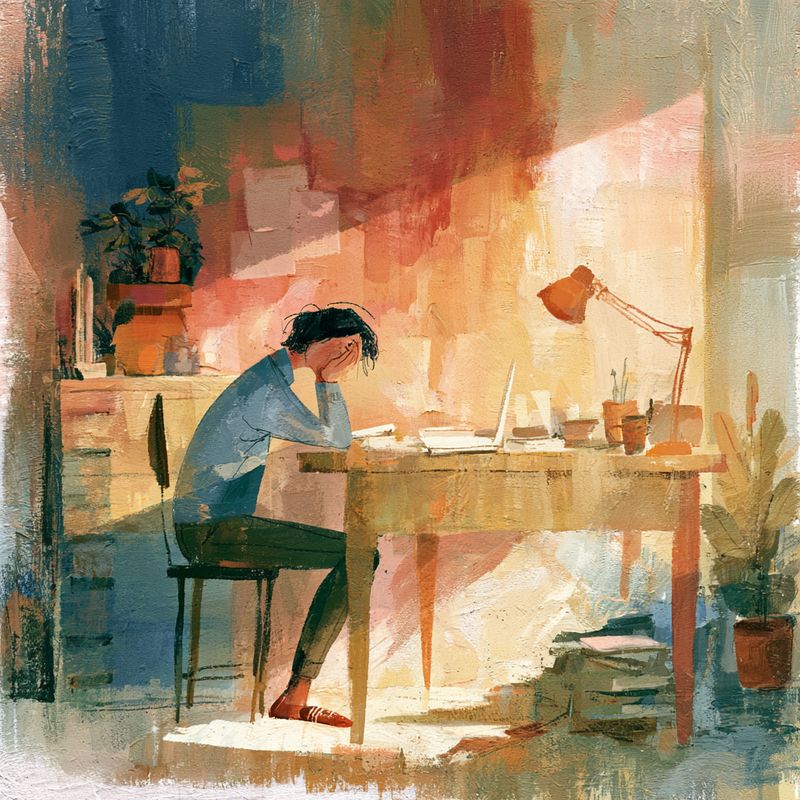
The uncomfortable truth is that deadline pressure kills creativity far more reliably than it sparks it, and the journalists, writers, and knowledge workers who’ve built their identity around ‘working well under pressure’ may be fooling themselves.
This isn’t a motivation problem. It’s a neuroscience problem. When time pressure intensifies, your brain physically reroutes itself away from the architecture that produces creative work. The result is faster output, yes. But also flatter, safer, less original output. Rushing makes work worse in measurable, reproducible ways, and the research on this is surprisingly clear.
What actually happens in the brain when a deadline closes in?
The brain doesn’t experience a tight deadline as an exciting challenge. It experiences it as a threat. That distinction matters enormously for creative output.
When time pressure kicks in, the amygdala, the brain’s fear and stress processing center, ramps up activity. According to fMRI studies cited in The Eureka Factor by neuroscientists John Kounios and Mark Beeman, individuals working under tight deadlines show increased amygdala activation alongside decreased activation in the anterior cingulate cortex, the region most closely associated with creative processing and insight.
In plain terms: the tighter the deadline, the more your brain shifts into survival mode.
Kounios and Beeman, writing in The Eureka Factor (2015), explain that time pressure and stress actually shift brain activity away from the right hemisphere, where insight and creative breakthroughs occur, toward the left hemisphere’s more analytical, focused processing. You become better at executing known solutions. You become significantly worse at finding new ones.
This hemispheric shift isn’t subtle. Research by Baas, De Dreu, and Nijstad published in the Journal of Personality and Social Psychology (2008) found that time pressure reduces creative thinking performance by approximately 45% in cognitive tasks requiring novel solutions. Nearly half your creative capacity, gone, because the clock is ticking.
Why do we believe the ‘pressure fuels creativity’ myth in the first place?
The myth is persistent because it contains a grain of truth. Deadlines do produce output. Journalists file. Writers submit. Campaigns launch. The work gets done.
What’s harder to measure is whether that work was as good as it could have been. When you’re racing a clock, you don’t have time to notice that your article has no real angle, or that the opening paragraph is technically competent but utterly forgettable.
Kounios and Beeman also found in their research, published in the Proceedings of the National Academy of Sciences, that the relaxed brain is more creative. When you’re under time pressure, your brain narrows its focus, which can actually prevent the associative thinking necessary for creative insight. The moments of genuine originality, the unexpected connection between two unrelated ideas, the fresh framing that makes a story sing, those require a kind of mental wandering that pure deadline pressure shuts down.
There’s also a confirmation bias at play. When a piece comes together under pressure, writers remember the pressure as the cause. When it doesn’t come together, they blame other things: the brief, the source, the edit. The pressure rarely gets the blame it deserves.
In the Adobe Creative Confidence Study (2012), 73% of creative professionals reported that self-imposed deadline pressure actually harms their creative output quality. That number is striking precisely because it’s self-imposed pressure. These aren’t external editorial deadlines. These are writers and designers doing it to themselves, and still reporting worse results.
How does time pressure creative block spiral into something worse?
The neuroscience of creative block under time pressure follows a predictable and fairly cruel pattern.
As astronaut Chris Hadfield describes in An Astronaut’s Guide to Life on Earth (2013), under extreme pressure, people tend to narrow their focus to immediate threats. This tunnel vision is great for surviving a crisis, but terrible for creative problem-solving, which requires broader perspective.
For a journalist staring at a blank document with two hours to deadline, the immediate threat is the blank document. So the brain locks onto it, hard. Every cognitive resource gets directed at the problem in front of you. The broader context, the surprising angle, the connection to something you read last week: all of that gets filtered out because the threat-detection system has decided it isn’t relevant right now.
Then a second layer kicks in. Steven Pressfield, in The War of Art (2002), argues that pressure and stress activate what he calls Resistance, the internal force that works against creative output. The tighter the deadline, the more internal resistance amplifies, paradoxically making creative work harder, not easier.
This is time pressure creative block in its fully developed form: the brain locked into survival processing, actively suppressing the associative thinking that would solve the problem, while internal resistance mounts. Rushing makes work worse not just because of the output quality, but because it generates a feedback loop that makes the next creative attempt harder too.
What does performance psychology say about reclaiming creativity under constraints?
None of this means deadlines should be abolished, or that creative professionals are helpless. Performance psychology offers several well-evidenced approaches to working with your brain’s architecture rather than against it.
Create pre-deadline incubation time. Research on the incubation effect, documented extensively in creativity studies, consistently shows that stepping away from a problem before the final push produces better solutions than grinding through it. Even twenty minutes away from the work, doing something low-demand, allows the brain’s default mode network to run associative processing in the background. Build this into your workflow deliberately, not as procrastination, but as scheduled creative infrastructure.
Reframe the stakes before you start. The amygdala’s threat response is triggered by perceived danger, and perceived danger is malleable. Techniques drawn from cognitive behavioral therapy and used widely in performance coaching involve consciously reframing the deadline as a parameter rather than a threat. This isn’t positive thinking. It’s a practical attempt to reduce amygdala activation before you sit down to write.
Use constraints earlier, not later. Counter-intuitively, introducing creative constraints in the early stages of a project, word count limits, format restrictions, topic boundaries, can actually enhance creative output by reducing the cognitive load of infinite possibility. The problem is when those constraints arrive at the end, in the form of a shrinking clock, with no creative scaffolding already in place.
Separate generation from evaluation. One of the most consistent findings in creativity research is that simultaneous generation and evaluation kills novel output. Under deadline pressure, writers tend to judge each sentence as they write it, deleting before they’ve produced enough raw material to work with. A deliberate separation, even fifteen minutes of uncritical drafting before any editing begins, can interrupt this pattern.
Pressfield, in Turning Pro (2012), makes a related point: “The professional has learned that Resistance will never go away. But like any addiction, we can manage it and overcome it.” Managing the conditions that amplify Resistance, including unnecessary time pressure, is part of professional creative practice.
How can you design your work environment to protect creative thinking?
The most underrated insight from the neuroscience here is that creative thinking isn’t something you do. It’s something you protect conditions for.
This shifts the question from ‘how do I think more creatively under pressure?’ to ‘how do I structure my work so that pressure arrives after the creative work is done, not during it?’
In practice, this means front-loading the divergent thinking phase. The associative, right-hemisphere work that produces genuine insight should happen early, when time isn’t yet tight. The convergent work, editing, structuring, polishing, is more compatible with time pressure because it draws on the left-hemisphere analytical processing that deadline mode actually enhances.
It also means being honest about which deadlines are real and which are self-generated anxiety. Knowledge workers are often their own harshest deadline architects, setting internal targets that trigger all the neurological costs of time pressure with none of the external necessity. The Adobe Creative Confidence Study finding about self-imposed pressure is a useful mirror here.
Finally, it means building recovery time between high-pressure outputs. The brain’s creative architecture doesn’t reset immediately after a stressful deadline. Research on cognitive recovery suggests that sustained pressure over multiple deadline cycles compounds the narrowing effect, making each subsequent creative attempt incrementally harder.
FAQ
Does deadline pressure ever genuinely help creativity?
For tasks that require speed and execution of known skills, yes. Deadline pressure can sharpen focus and reduce perfectionism-driven delay. But for tasks requiring novel thinking, original angles, or genuine insight, the neuroscience is consistent: time pressure reduces creative performance. The key is matching the type of pressure to the type of task, and protecting the creative phase from deadline stress.
Why do so many creative professionals insist they work best under pressure?
Mostly because pressure reliably produces output, and output feels like creative success in the moment. What’s harder to assess is counterfactual quality: how good the work might have been with more protected creative time. The 73% figure from the Adobe Creative Confidence Study (2012) suggests that when creative professionals reflect honestly, most recognise the cost.
What is the amygdala’s role in creative block?
The amygdala processes threat and triggers the brain’s stress response. Under deadline pressure, increased amygdala activation competes with and suppresses the anterior cingulate cortex, which handles the broader associative processing that creative work depends on. Essentially, the fear center and the creativity center are competing for resources, and under stress, fear wins.
How much time away from a problem actually helps with creative insight?
Studies on the incubation effect vary, but even short breaks of 15 to 30 minutes have shown measurable improvements in subsequent creative problem-solving. Longer incubation periods of several hours or overnight produce more significant effects. The key is that the break should involve low-demand activity, not switching to another high-stress task.
Can procrastination ever protect creative thinking?
Structured delay, deliberately leaving the creative problem open before sitting down to produce, can allow unconscious associative processing to run and improve output quality. This is different from avoidance-based procrastination, which tends to compound deadline pressure. The distinction matters: intentional incubation builds creative capacity, while unmanaged delay destroys it. Tools that help you structure that incubation time productively sit at the intersection of both.