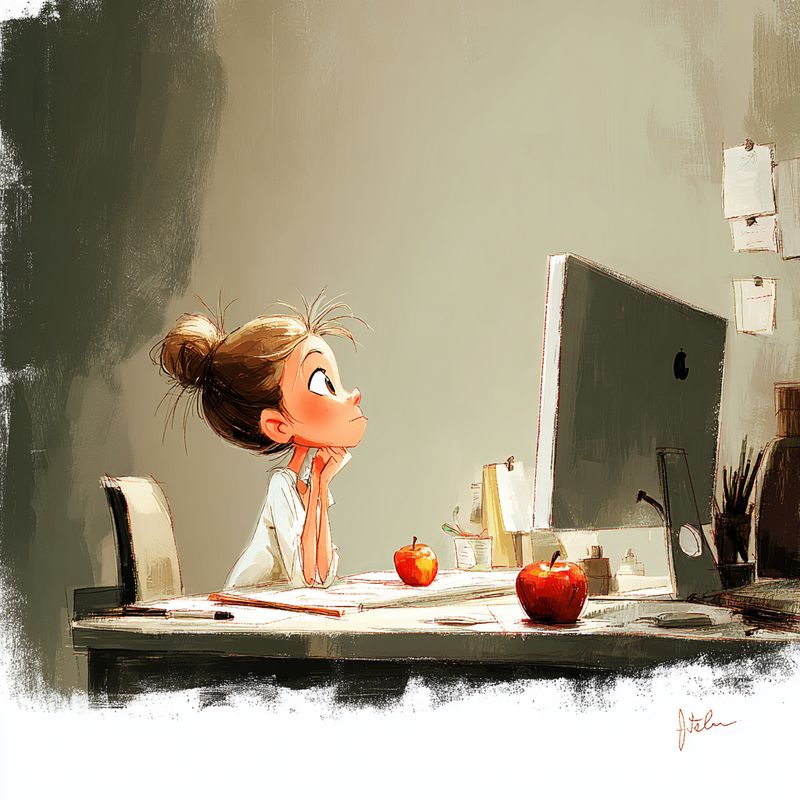
Creative block isn’t a character flaw. It’s a signal, and once you learn to read it correctly, getting unstuck creatively becomes less about forcing inspiration and more about radically shrinking your starting point.
The wall you’re staring at isn’t made of laziness or lack of talent. It’s almost always built from scope. The project feels too big, the stakes feel too high, and your brain responds by doing the only sensible thing: it stalls. Research and behavioral science both point to the same fix, and it’s smaller than you think.
Why Does Creative Block Feel So Physically Heavy?
Creative block doesn’t just feel frustrating. It often feels like a physical weight, a genuine inability to move. That sensation has a neurological basis, not a motivational one. Understanding the difference changes everything about how to start creative work.
Neuroscientist Andrew Huberman, across multiple episodes of the Huberman Lab Podcast covering motivation and neural circuits (2021-2023), has explained that most people have the relationship between motivation and action backwards. According to Huberman’s synthesis of the research, initiating action is what generates motivation, not the other way around. Waiting to feel ready before starting is, neurologically speaking, a trap.
This matters because most advice about creative block targets motivation directly. Just get inspired. Find your why. Reconnect with your passion. That advice isn’t wrong exactly, but it addresses the wrong variable first.
Approximately 20% of people chronically struggle with procrastination, according to Piers Steel’s widely-cited meta-analysis published in Psychological Bulletin in 2007. A significant proportion of that procrastination isn’t about laziness. It manifests specifically as creative avoidance: the inability to begin work that feels meaningful, high-stakes, or personally exposing.
The heaviness isn’t resistance to work. It’s resistance to the size of what you’ve decided the work needs to be.
What Does Resistance Actually Signal About Your Project?
Here’s the contrarian read: resistance isn’t telling you to stop. It’s telling you the current version of your project is too large to begin.
When you sit down to write a novel, paint a series, or build a creative business and nothing comes out, the block isn’t about the work itself. It’s about the unit of work you’ve defined. Your brain can’t locate a clear, achievable starting point, so it defaults to avoidance.
Organizational psychologist Adam Grant, in his 2016 book Originals: How Non-Conformists Move the World, drew on research into productive procrastination to argue that the problem for many creators isn’t that they start too late. It’s that the pressure to produce something great prevents them from starting at all. Grant later reinforced this in Think Again: The Power of Knowing What You Don’t Know (2021), noting that beginning with something deliberately imperfect removes that pressure entirely.
The signal buried inside creative block, read correctly, is this: reduce scope now.
Not permanently. Not as a concession. As a strategy.
How Does Starting Absurdly Small Actually Create Momentum?
Micro-creation for blocked artists isn’t a consolation prize. It’s the mechanism through which real momentum builds, and the behavioral science behind it is solid.
BJ Fogg, director of the Behavior Design Lab at Stanford University, outlines in his 2020 book Tiny Habits: The Small Changes That Create Remarkable Results that motivation is fundamentally unreliable. Rather than waiting for motivation to arrive, Fogg argues the evidence supports designing behavior so it happens naturally, with minimal willpower required. The specific prescription: start absurdly small. A tiny version of the behavior you want, Fogg explains, is the key to building lasting habits precisely when motivation is lowest.
Research from Fogg’s lab at Stanford (2019-2020) found that committing to just a two-minute version of a task significantly increases follow-through compared to tasks with undefined or ambitious starting points.
Two minutes. One paragraph. A single rough thumbnail sketch.
These aren’t compromises on your creative vision. They’re the scientifically-backed pathway to it. Tiny creative projects generate the one thing that perfectionist goals never can: actual evidence that you’re capable of beginning.
Art Markman, cognitive scientist at the University of Texas, has written extensively in his Brain Briefs research that goals become more achievable when broken into smaller milestones. The motivation to continue, Markman explains, comes from seeing progress, not from the magnitude of the eventual outcome. A finished rough paragraph produces more psychological momentum than a half-imagined finished novel.
What Does a Micro-Creation Practice Actually Look Like?
The phrase “start small” gets repeated so often it has lost all practical meaning. What it actually looks like in practice is more specific, and more useful, than the cliché suggests.
A micro-creation session isn’t a warm-up for real work. It is the work, at a scale your brain can accept without triggering avoidance. Five minutes on a single visual idea. One sentence that doesn’t need to connect to anything yet. A voice memo of a half-formed concept. A rough color study with no intention of sharing.
The key distinction: these aren’t meant to be kept secret from your larger project. They’re meant to feed it. What often happens, consistently reported by practitioners of this approach, is that the five-minute sketch reveals the direction the larger piece needs to go. The single paragraph contains the thesis the whole essay was circling around.
This is partly what Grant’s procrastination research captures. In Originals, he noted that procrastination can actually boost creativity when it gives the mind time to make unexpected connections, provided there’s still enough time to act on them. Tiny creative projects create that connective space without the paralysis of a blank, undefined starting point.
The practical framework looks like this:
- Define the smallest possible unit of your creative work (one sentence, one thumbnail, one voice note, one color)
- Commit to only that unit, not “getting started on the bigger thing”
- Remove any performance expectation from that unit entirely
- Do it before opening email, social media, or any other tab
The last point matters more than it sounds. How to start creative work is partly an environment design question, which is exactly what Fogg’s behavior design research emphasizes: structure the conditions so the behavior happens naturally, rather than relying on willpower to overcome resistance.
Why Perfectionism Isn’t the Root Problem (And What Is)
Perfectionism gets blamed for creative block constantly, and it’s not entirely wrong. But framing the whole problem as perfectionism leads to advice that doesn’t work, mostly because it tells people to simply care less, which isn’t a real strategy.
The actual root problem is scope mismatch: the gap between the size of the project in your head and the size of the action your current state can support. Perfectionism is just one driver of scope inflation. Fear is another. Unclear direction is another. Excitement about the finished version, paradoxically, is another.
When the scope is reduced to match what you can actually do right now, the perfectionism problem largely dissolves. It’s very hard to be precious about a five-minute rough sketch. The low stakes of the micro-task bypass the defense mechanisms that block larger efforts.
A creative block breakthrough, in most documented cases, doesn’t look like a sudden flood of inspiration. It looks like a tiny action that didn’t feel like enough, followed by another slightly larger one, followed by momentum that builds faster than expected.
That’s not motivational language. That’s how behavior change actually works, according to decades of research across behavioral science, cognitive psychology, and neuroscience.
If you’re stuck, the project isn’t broken. The unit size is.
FAQ
Is creative block a sign that I’m working on the wrong project?
Not necessarily. Creative block more often signals that the scope or starting point of the right project is too large. Before abandoning a project, try reducing it to its smallest possible first action and see whether the resistance lifts. If it does, the project is likely fine. If block persists even at the smallest scale, it may be worth examining whether the project genuinely aligns with your current priorities.
How long should a micro-creation session be?
BJ Fogg’s behavior design research suggests that two to five minutes is enough to trigger follow-through and break the avoidance cycle. The goal isn’t to produce finished work in that window. It’s to cross the threshold between not-started and started, which neuroscience suggests is where motivation actually gets generated.
Won’t tiny creative projects produce only tiny results?
This is the most common misconception about micro-creation for blocked artists. Tiny sessions aren’t intended to replace longer creative work. They’re designed to initiate it. In practice, a two-minute commitment frequently extends naturally once the avoidance barrier is crossed. The research on habit formation consistently shows that the hardest part is beginning, not continuing.
Does this approach work for all creative disciplines?
The underlying behavioral mechanism (reducing scope to match current capacity) applies across disciplines because it addresses how the brain responds to overwhelming goals, not the specifics of any one creative form. Writers, visual artists, musicians, and designers have all applied versions of this approach. The specific micro-task looks different (one sentence vs. one sketch vs. one chord progression), but the principle holds.
What if I do the tiny task and still feel stuck afterward?
That happens, and it’s useful information. If completing a genuinely minimal creative action doesn’t produce any forward movement or clarity, it’s worth examining external factors: sleep, workload, whether the project needs more research or input before creation is possible. Getting unstuck creatively isn’t always a behavior design problem. Sometimes the block is a legitimate signal that more information or rest is needed before the work can move forward.