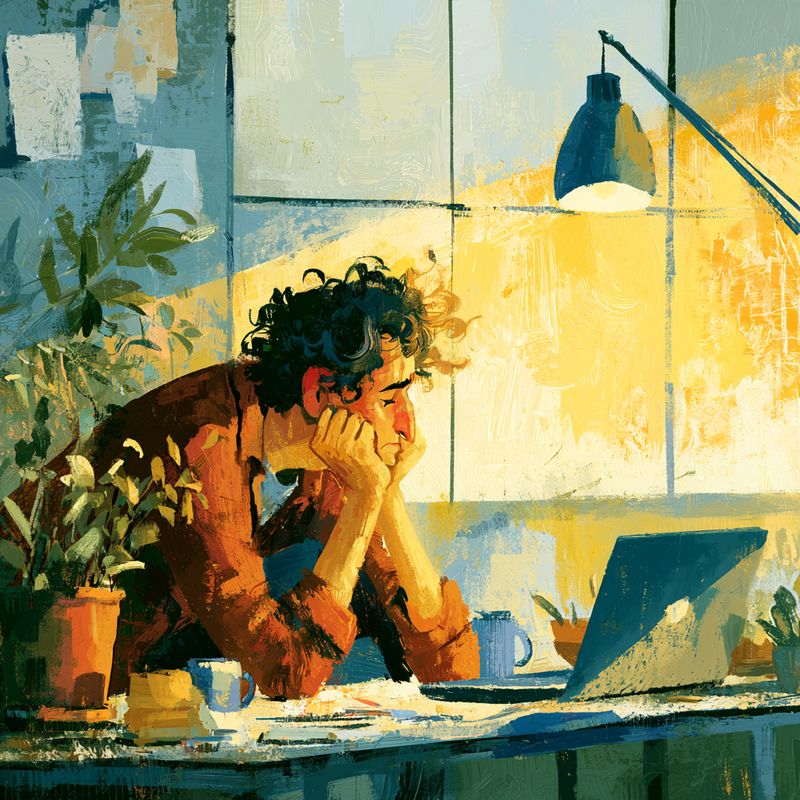
Most actors don’t burn out from rejection. They burn out from the weight they assign to each individual audition before they’ve even walked in the room.
Audition anxiety pressure is one of the most well-documented stressors in the performing arts. Actors and performers report stress levels 2 to 3 times higher than the general population, according to entertainment industry mental health surveys compiled by the SAG-AFTRA Foundation (2019). That’s not a small gap. And when every audition feels like a referendum on your worth, your talent, and your future, that gap only widens. The good news is that the exhaustion isn’t inevitable. Research from psychology and neuroscience points to specific, evidence-based ways to reframe the experience without pretending the stakes aren’t real.
Why Does Every Audition Feel Like a Make-or-Break Moment?
The short answer: your brain is doing exactly what it was designed to do. Threat detection is a survival mechanism, and when you’ve tied your identity to an outcome, your nervous system treats that outcome as a genuine threat to your existence.
Acting audition stress operates through a well-worn neurological loop. You prepare intensely, which signals to your brain that this matters. The brain registers importance as risk. Risk triggers the stress response. And the stress response, when chronic, starts to distort your perception of frequency and severity.
Performance anxiety affects approximately 8 to 10% of the general population significantly enough to impact daily functioning, according to research summaries from the American Anxiety and Depression Association (2020). For performers who audition repeatedly, that baseline anxiety compounds. Each audition doesn’t just feel high-stakes in isolation. It accumulates. The fifth audition in a month carries the emotional residue of the previous four.
The result is what psychologists call hypervigilance to threat cues: a state where your nervous system is constantly scanning for danger, even when the actual danger is just a casting director checking their phone.
What Chronic Audition Fear Actually Does to Your Performance
Here’s the uncomfortable truth most acting coaches won’t say out loud: treating every audition like it’s your last one doesn’t make you more committed. It makes you worse at auditioning.
Chronic stress from repeated high-stakes situations can lead to a 20 to 30% decrease in cognitive performance and decision-making ability, according to stress and performance research published by the American Psychological Association (2018). For actors, cognitive performance isn’t abstract. It’s your ability to listen, respond spontaneously, make bold choices, and stay present in the room. Audition fear actively degrades the very skills you’re trying to demonstrate.
The emotional exhaustion of auditioning also creates a paradox that most performers recognize but can’t seem to escape. The more desperate you feel walking in, the more that desperation reads on camera or on stage. Casting directors aren’t imagining it. What they’re seeing is a nervous system that’s treating an audition like a threat rather than an opportunity.
In his 2013 research on emotion regulation, Stanford psychologist James Gross found that reappraisal, which means changing how you think about an emotion-eliciting situation, is one of the most effective emotion regulation strategies available. Not suppression. Not deep breathing alone. Reappraisal: actually shifting the cognitive frame around the event itself.
That’s a meaningful distinction for actors. Telling yourself to calm down doesn’t work. Telling yourself a different true story about what the audition actually is can.
How Stress Mindset Shifts Change the Biology, Not Just the Feeling
The science of stress reappraisal has moved well beyond self-help territory. Health psychologist Kelly McGonigal, in her 2015 book The Upside of Stress, makes a case that changes how most people think about anxiety entirely.
“Stress is enhancing. It’s preparing you to meet the challenge.”
McGonigal’s argument isn’t that stress is harmless. It’s that your interpretation of the stress response physically changes what that response does to your body. In her 2013 TED Talk, How to Make Stress Your Friend, she put it directly: “When you change your mind about stress, you can change your body’s response to stress.”
For actors, this reframe is unusually practical. The physical symptoms of audition anxiety, the racing heart, the heightened alertness, the surge of energy, are physiologically almost identical to excitement. The difference is the story you attach to those sensations. “I’m terrified” and “I’m ready” can produce the same heartbeat. Only one of them helps you perform.
This isn’t positive thinking. It’s applying what researchers call a “stress-is-enhancing” mindset, which McGonigal’s work shows produces measurably different cortisol and DHEA ratios compared to a “stress-is-harmful” mindset. Your biology responds to your interpretation.
What Self-Talk Strategies Actually Reduce Audition Anxiety Pressure
The internal monologue running through an actor’s head before an audition is often brutal. “Don’t mess this up.” “You need this.” “This is your shot.” That kind of self-talk doesn’t sharpen focus. It narrows it into panic.
Ethan Kross, a psychologist at the University of Michigan and author of Chatter: The Voice in Our Head and How to Harness It (2021), has spent years studying exactly this. His research makes one thing clear: the conversations we have with ourselves matter enormously, and they can either fuel anxiety or help manage it.
One of his most replicated findings involves a deceptively simple technique. Using your own name or the pronoun “you” when talking to yourself, rather than “I”, creates psychological distance from anxious thoughts. So instead of “I’m so nervous, I can’t do this,” you’d say, “Sarah, you’ve prepared for this. You know what to do.” Kross’s emotion regulation research across multiple studies between 2014 and 2021 shows this distanced self-talk reduces activity in brain regions associated with threat and self-referential rumination.
For actors dealing with emotional exhaustion from auditioning, this technique offers something concrete to practice before they walk through the door. It’s not about faking confidence. It’s about creating enough psychological space to access the skills that are already there.
A second strategy drawn from the same research base involves reframing the audition itself. Instead of framing it as “proving yourself,” frame it as “showing them something.” The shift sounds small. The neurological effect isn’t. “Proving” activates threat; “showing” activates approach motivation, which is the psychological state associated with curiosity, creativity, and better performance.
How to Break the Cycle Without Pretending Auditions Don’t Matter
The goal isn’t detachment. Actors who don’t care don’t give interesting performances. The goal is what researchers call “optimal stress calibration”: caring enough to be fully present, without the hyperactivation that collapses your range.
Several evidence-based practices can help reorient an actor’s relationship with audition fear without dismissing the genuine stakes involved.
Treat each audition as a data point, not a verdict. A single audition tells you almost nothing reliable about your talent or your future. Casting decisions involve factors entirely outside your control: physical type, chemistry with another actor, budget changes, a director’s recent divorce. Treating each audition as feedback in a long data set changes the emotional weight of any single result.
Build a pre-audition ritual that signals safety, not urgency. Research on pre-performance routines shows that consistent rituals reduce cortisol spikes by anchoring the nervous system in familiarity. The ritual doesn’t need to be elaborate. A specific playlist, a particular warmup sequence, a consistent arrival time. Predictability is calming at a neurological level.
Separate preparation from outcome. Your job, as defined by what you can actually control, ends when you walk into the room fully prepared. What happens after that belongs to a system you didn’t design and can’t override. This isn’t resignation. It’s accurate scope management. It’s also, not coincidentally, how the least anxious high-performing actors tend to describe their approach.
Track your auditions like a professional, not a supplicant. Logging what you worked on, what felt alive in the room, what you’d do differently, shifts your identity from someone waiting to be chosen to someone building a craft. That identity shift is one of the most durable antidotes to the emotional exhaustion that comes with treating every audition as a crisis.
FAQ
Q: Is audition anxiety normal, or is it a sign I’m not cut out for acting? A: Audition anxiety is nearly universal among performers. Actors and performers report stress levels 2 to 3 times higher than the general population (SAG-AFTRA Foundation, 2019), which means high anxiety in audition settings is the norm, not an exception. It doesn’t signal unsuitability. It signals that you’re treating the audition as genuinely important, which is a starting point, not a disqualification.
Q: Does stress reappraisal really work, or is it just rebranding anxiety as excitement? A: It’s more physiologically grounded than it sounds. Kelly McGonigal’s research, detailed in The Upside of Stress (2015), shows that a stress-is-enhancing mindset produces measurably different hormonal responses compared to viewing stress as harmful. The reappraisal isn’t cosmetic. It changes what the stress response actually does inside your body.
Q: How do I stop catastrophizing before auditions when the stakes genuinely are high? A: Ethan Kross’s research on distanced self-talk, published across multiple studies between 2014 and 2021, suggests addressing yourself by name rather than using “I” when anxious thoughts spiral. This creates psychological distance and reduces rumination. Combined with James Gross’s work on cognitive reappraisal, the practical answer is: don’t fight the anxiety, reframe what the audition actually represents.
Q: Why does treating every audition like it’s critical actually hurt my performance? A: Chronic stress from repeated high-stakes situations can decrease cognitive performance and decision-making ability by 20 to 30%, according to American Psychological Association research (2018). For actors, this directly impairs listening, spontaneity, and bold choices, the precise qualities casting directors are looking for. The high-stakes framing is self-defeating.
Q: How many auditions does it take before the anxiety gets better? A: Volume alone doesn’t reduce anxiety. What changes the experience is how you interpret and process each audition afterward. Actors who treat individual auditions as data points in a long career arc, rather than verdicts on their worth, consistently report lower emotional exhaustion over time. The number matters less than the framework you bring to each one.