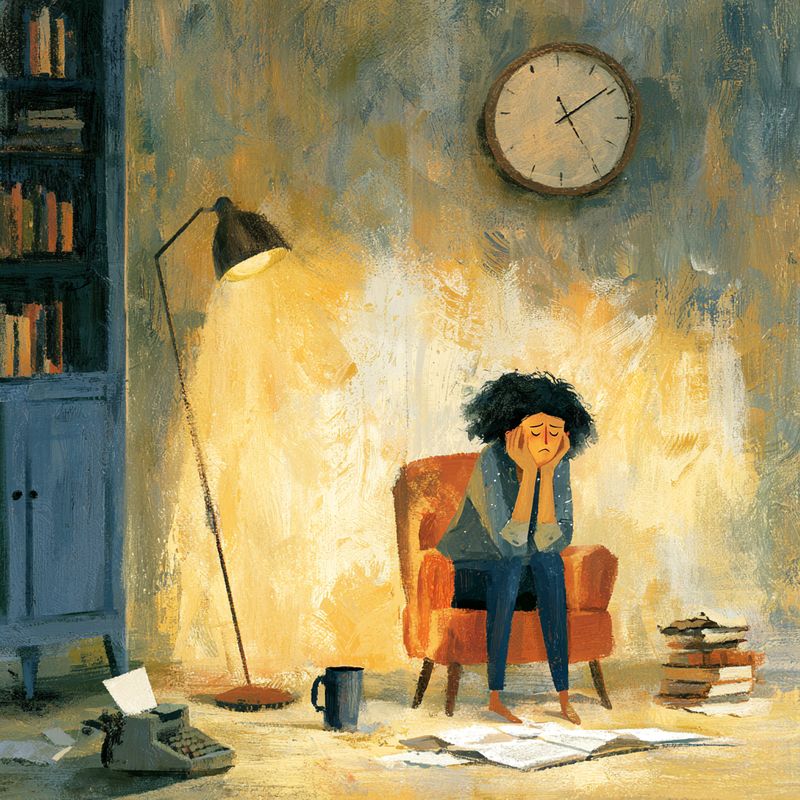
Submission avoidance costs actors roles they never even get rejected from. Every day you delay sending headshots or put off audition prep, a casting director fills that slot with someone who showed up. The hard truth: waiting to apply for roles doesn’t protect you from failure. It guarantees it.
Actor procrastination submissions are one of the most damaging patterns in a performer’s career, precisely because the damage is invisible. You don’t feel rejected. You just never hear back. And the brain, conveniently, lets you off the hook.
Why do actors delay sending submissions in the first place?
Submission avoidance isn’t about being disorganised or lazy. Research consistently frames it as an emotion regulation problem: actors delay sending headshots because the act of submitting triggers anxiety, and the brain responds by finding reasons to wait.
In his 2016 book Idiot Brain, neuroscientist Dean Burnett explains that procrastination is linked to emotional regulation issues. We delay tasks not because we’re lazy, but because we’re trying to manage negative emotions associated with the task. For actors, those negative emotions are unusually concentrated. Every submission carries the possibility of silence, of rejection, of being told (implicitly) that you’re not what they’re looking for.
Burnett also notes that the brain’s reward system prefers immediate gratification over long-term goals, which is why procrastination feels good in the moment. Closing the casting website and watching something on Netflix produces immediate relief. That relief is real. The cost of it, a missed opportunity, only becomes apparent later, if at all.
This is why willpower-based advice (just start, set a timer, commit to five minutes) fails so many people. It treats the symptom without addressing the underlying emotional avoidance.
What is the real cost of waiting to apply for roles?
The maths on submission avoidance is brutal, and most actors underestimate it significantly. Procrastinators delay an average of 2 to 3 critical tasks per week, according to a 2006 meta-analysis by Steel and König on procrastination prevalence. For an actor, those delayed tasks are often submissions.
Multiply that across a year and you’re looking at over 100 missed opportunities before a single audition has even been declined.
Piers Steel’s 2007 meta-analysis in Psychological Bulletin found that between 15 and 20% of adults are chronic procrastinators. Among creatives in high-rejection industries, that number almost certainly skews higher. The shame attached to performing careers, where your face and voice and body are the product, creates fertile ground for avoidance.
Research from Psychological Review in 2010 found that fear of negative evaluation is cited as a reason for procrastination in 60% of cases studied. That figure maps almost perfectly onto what actors describe when they explain why they put off audition prep or delay sending headshots: they don’t want to know the answer yet.
But here’s the contrarian point worth making plainly: rejection from a submission you sent is recoverable. You learn something, you move on, you submit again. The roles you never applied for don’t teach you anything. They just disappear.
How does performance anxiety create a self-protective delay pattern?
The pattern tends to follow a predictable loop. An actor finds a suitable role, feels a spike of hope, immediately followed by anxiety about whether they’re right for it, then starts “preparing properly” before submitting, which becomes a reason to wait, which becomes procrastination, which becomes a missed deadline.
In Eat That Frog! (2007), productivity researcher Brian Tracy observes that the fear of starting is often greater than the actual difficulty of doing the task. For actors, the submission itself takes minutes. The emotional labour of deciding to submit can take days.
Tracy’s framework is useful here. He argues that you must develop the habit of eating the frog first thing in the morning, where the frog is that one task most important to your success. For working actors, submissions are the frog. They’re not glamorous. They don’t feel like acting. But they are the mechanism through which everything else becomes possible.
Performance anxiety doesn’t only strike on stage. It strikes at the laptop, at the moment of clicking send. The actor who waits to apply for roles until they feel “ready” is waiting for a neurological state that submission avoidance actively prevents from arriving.
Does perfectionism make submission avoidance worse?
Perfectionism and submission avoidance are deeply connected, and the relationship runs in both directions. Perfectionism generates reasons to delay (the headshot isn’t quite right, the cover note needs another draft, the showreel needs updating). Avoidance then reinforces perfectionism by creating a self-narrative that you’re simply being thorough.
In Originals (2016), organisational psychologist Adam Grant makes a point that reframes this usefully. Grant writes that procrastination may be the enemy of productivity, but it can be the friend of creativity. He’s describing a specific kind of deliberate, generative delay where incubation produces better ideas. But he’s equally clear that this is different from avoidance-driven delay, which doesn’t generate creative output. It generates anxiety.
Grant also notes that pre-crastination, doing things immediately without thinking them through, can be worse than procrastination. This is worth holding onto. The goal isn’t frantic, unconsidered submissions. It’s timely, consistent, well-targeted ones. Perfectionism distorts this by making “good enough and sent” feel inferior to “perfect and never sent.” It isn’t.
Tuckman’s Procrastination Scale studies from 1991 found that 95% of procrastinators report that procrastination has negative consequences on their lives. Most actors who delay sending submissions already know, on some level, that it’s costing them. The knowledge doesn’t fix the pattern. Understanding the emotional mechanism is what creates the opening for change.
How can actors break the submission avoidance cycle?
The most effective interventions for actor procrastination submissions target the emotional trigger, not the task itself. Several research-backed approaches are worth building into a working practice.
Separate the decision from the action. Instead of deciding whether to submit at the moment of submitting, create a rule in advance. If a role fits two or three defined criteria, you submit. No further deliberation. This removes the emotional decision point from the moment of highest anxiety.
Use implementation intentions. Research by Peter Gollwitzer, published in American Psychologist in 1999, found that specifying when, where, and how you’ll perform a task dramatically increases follow-through. “I will check casting breakdowns at 9am on weekday mornings and submit immediately to anything that fits” outperforms “I’ll try to stay on top of submissions.”
Reduce the size of the action. The resistance to putting off audition prep often comes from mentally bundling the submission with every task adjacent to it (updating the headshot, rewriting the bio, overhauling the showreel). Submissions and prep are separate tasks. Submit with what you have. Improve materials separately.
Track what you don’t submit for. Most actors only track auditions and callbacks. Tracking roles you saw but didn’t apply for creates a visible record of avoidance costs. It’s uncomfortable. That discomfort is useful.
Time-bound your preparation window. If you need to put off audition prep by one day to make a submission stronger, schedule that day and hold it. If preparation bleeds past that window, submit anyway. The role won’t wait.
FAQ
Is submission avoidance the same as laziness?
No, and conflating the two makes the problem harder to solve. Research, including Dean Burnett’s work in Idiot Brain (2016), frames procrastination as an emotional regulation response. Actors who delay sending headshots aren’t avoiding work because they’re unmotivated. They’re avoiding the anxiety that submitting triggers. The fix requires addressing the emotion, not adding discipline.
How many opportunities does submission avoidance actually cost?
The cumulative cost is significant. Research by Steel and König (2006) found that procrastinators delay an average of 2 to 3 critical tasks per week. For actors, those delayed submissions compound quickly. Over a year, consistent submission avoidance can mean over 100 missed opportunities, none of which register as rejections because the application was never sent.
Why does waiting to apply for roles feel rational even when it isn’t?
Because the brain registers immediate emotional relief when you close the casting tab and defer the submission. That relief is neurologically real. As Dean Burnett explains, the brain’s reward system prioritises immediate comfort over long-term goals. Waiting feels like a decision, which gives it a veneer of agency. It isn’t a decision. It’s avoidance dressed as strategy.
Can some delay in submissions actually be useful?
In narrow circumstances, yes. Adam Grant’s research in Originals (2016) identifies that a degree of deliberate delay can improve creative thinking. But Grant distinguishes this from anxiety-driven avoidance. A short, intentional preparation window (one defined day to sharpen your materials) is different from indefinite deferral driven by fear. The key word is intentional: you set an end point and you honour it.
What’s the single most effective change an actor can make to reduce submission avoidance?
Create a decision rule before the anxiety hits. Decide in advance which criteria make a role worth submitting for, then treat submission as automatic when those criteria are met. This removes the emotionally loaded deliberation from the moment of highest resistance. Brian Tracy’s advice in Eat That Frog! (2007) applies directly: identify the submission task as the most important daily action and complete it before anything else competes for your attention.