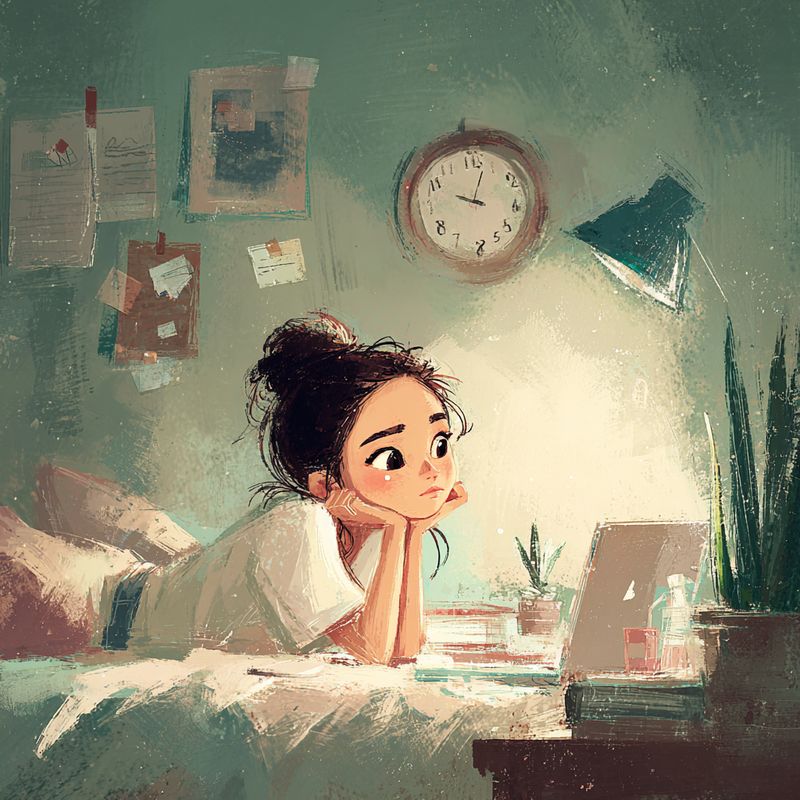
Your parents are sitting three feet away. They keep glancing over. You know you need to finish this assignment. And somehow, you’ve read the same paragraph six times.
This isn’t laziness, and it isn’t defiance. Neuroscience has a much more interesting explanation for why procrastinating with parents around is actually harder to stop than procrastinating alone. Parental pressure, counterintuitively, tends to make homework avoidance worse rather than better. Research on performance anxiety, autonomy, and attention fragmentation explains exactly why the homework gets harder the moment someone starts watching you do it.
Why does having someone watch you work make it harder to focus?
When another person observes you performing a task, your brain shifts part of its processing power toward self-monitoring. You stop thinking about the work itself and start thinking about how you look doing the work. Psychologists call this the “spotlight effect,” and it consistently degrades performance on complex cognitive tasks.
Homework isn’t a simple mechanical task. Writing an essay, solving multi-step maths problems, or analysing a poem all require what Cal Newport describes in Deep Work: Rules for Focused Success in a Distracted World (2016) as genuine deep focus:
“The ability to perform deep work is becoming increasingly rare at exactly the same time it is becoming increasingly valuable in our economy. As a consequence, the few who cultivate this skill, and then make it the core of their working life, will thrive.”
Deep work requires cognitive immersion. A parent watching from the couch doesn’t just create mild discomfort. It actively competes for the same mental bandwidth the work itself demands.
The result is a student who looks like they’re procrastinating, because behaviourally they are, but the root cause isn’t avoidance of the task. It’s the brain protecting itself from the cognitive overload of doing the task while also managing social self-awareness.
What does the research say about pressure from parents and academic performance?
The relationship between parental pressure and student performance is well-studied, and the findings are consistently uncomfortable for parents who believe hovering helps.
According to research published in the Journal of Educational Psychology by Solomon and Rothblum (1984), 46% of students already report procrastinating on homework assignments under normal conditions. Add external surveillance to that baseline, and the self-interruption rate climbs further.
Gloria Mark, a cognitive scientist at UC Irvine, found in her digital distraction research (referenced in Multitasking in the Digital Age, 2015) that people typically only focus on a given task for about 3 minutes before being interrupted or self-interrupting. That 3-minute window shrinks further under observation because perceived evaluation triggers the same stress response as an actual interruption.
Mark’s research also showed that students and workers lose an average of 40 minutes per day to task-switching and context-switching costs alone. When a parent asks “how’s it going?” or simply shifts in their chair, they create exactly the kind of micro-interruption that resets that focus cycle from scratch.
The stress compounds too. Mark’s UC Irvine studies found that the more frequently people switch between tasks, the more stressed they feel, and that stress then leads to more distraction, which leads to more stress. A parent trying to reduce procrastination by staying present can inadvertently set this cycle spinning.
Does parental pressure ever actually help?
Here’s the contrarian take: pressure isn’t inherently destructive. The problem is misapplied pressure at the wrong developmental stage.
Astronaut Chris Hadfield, writing in An Astronaut’s Guide to Life on Earth (2013), argues that pressure focuses attention, but only if the person has trained properly beforehand. Without the underlying skill and self-regulation already in place, pressure doesn’t sharpen performance. It collapses it.
For high school students still building their study habits, external pressure from parents typically arrives before those internal systems are established. The student hasn’t yet developed the metacognitive scaffolding to perform under observation. So rather than sharpening focus, the pressure triggers what researchers call “ego depletion”, spending mental energy on managing the social dynamic rather than the actual work.
This is also why the same student who can’t focus on studying with a parent in the room might work productively in a library or coffee shop. Other people are present in those environments too, but they carry no evaluative stakes. Nobody in a coffee shop cares whether you finish your history essay.
What actually happens in the brain during homework avoidance under surveillance?
When the brain perceives evaluation, it activates the same threat-detection circuitry that responds to physical danger. The prefrontal cortex, which handles complex reasoning and sustained attention, starts competing with the amygdala’s threat-monitoring activity.
This neurological competition is why can’t-focus-on-studying complaints spike specifically in high-stakes observation scenarios. The student isn’t choosing to avoid the work. Their brain is functionally impaired for that work by the conditions surrounding it.
Dave Crenshaw, in The Myth of Multitasking (2008), argues that multitasking is a myth, and what people actually do is switch tasks rapidly, with each switch carrying a significant cognitive cost. Being observed while studying forces exactly this kind of involuntary task-switching: the student alternates between “process this paragraph” and “manage how I appear to my parent,” paying a cognitive tax on every switch.
Cal Newport, again in Deep Work, is direct about the consequence:
“Without deep work, you’re unlikely to produce the world-class results that increasingly define the bracket of jobs that are both lucrative and fulfilling.”
For students, the immediate stakes aren’t world-class results. They’re finishing tonight’s assignment. But the mechanism is identical. Fractured attention produces fractured output, regardless of how much time was technically spent at the desk.
And this is the real frustration that students struggle to articulate: they sat there for two hours, their parents saw them sitting there, and they still barely made progress. Because sitting at a desk under surveillance and actually doing deep cognitive work are two very different physiological states.
How can students (and parents) actually fix this?
Autonomy is the most evidence-backed lever here. Research in self-determination theory consistently shows that students perform better, retain more, and procrastinate less when they feel ownership over their study conditions.
That means the most productive shift isn’t finding better enforcement strategies. It’s removing the enforcement dynamic entirely.
A few practical reframings:
- Negotiate location, not supervision. A student studying in their room with a check-in at a fixed time (“I’ll show you what I’ve done at 9pm”) gets the accountability without the surveillance impairment.
- Replace watching with outcome tracking. Parents asking to see the finished assignment, rather than monitoring the process, shifts the student’s brain from “perform for an audience” to “complete a task.”
- Acknowledge the paradox explicitly. Some students find it genuinely helpful to explain to their parents that the watching is making it harder. This requires the student to have language for it, which is part of why articles like this one exist.
Steele and König, writing in Personality and Individual Differences (2006), found that 88% of working adults engage in procrastination at least occasionally. Procrastination isn’t a student character flaw. It’s a near-universal human response to aversive conditions, and “being watched while doing cognitively demanding work” qualifies as an aversive condition for most people.
The fix isn’t more pressure. It’s better conditions.
FAQ
Q: Is it normal to procrastinate more when my parents are watching me do homework? A: Yes, and the science backs it up. Research on the spotlight effect shows that being observed during complex cognitive tasks increases self-monitoring, which competes directly with the focus required for homework. It doesn’t mean you’re lazy. It means your brain is responding normally to an evaluative social environment.
Q: Why can’t I focus on studying even when I want to finish the work? A: Wanting to finish and being neurologically able to focus are separate things. Gloria Mark’s research at UC Irvine found that people self-interrupt roughly every 3 minutes under normal conditions. Add parental presence and the perceived threat of evaluation, and that window shortens further. The prefrontal cortex, which drives sustained attention, is directly impaired by stress and social self-consciousness.
Q: Does parental pressure ever improve homework performance? A: In rare, specific circumstances, yes. Research suggests that pressure can sharpen performance when the person already has strong underlying skills and self-regulation habits in place. For most high school students still developing those systems, pressure more often triggers avoidance than it resolves it.
Q: What should I tell my parents about why their watching makes things worse? A: Frame it around outcomes rather than conflict. Something like: “I actually get more done when you check in on the finished work rather than watching me do it” gives parents the accountability they want while removing the surveillance dynamic that impairs your focus. Proposing a specific check-in time also helps, because it replaces open-ended monitoring with a concrete endpoint.
Q: What’s the best study environment for someone who struggles with homework avoidance? A: Research points toward low-stakes social environments (libraries, quiet coffee shops) or private spaces with scheduled rather than continuous accountability. The key variables are: absence of evaluative observation, control over the physical space, and a clear defined work period with a known endpoint. Time Is Luck is built around exactly this kind of structured autonomy, helping you track focused work sessions without external surveillance pressure.