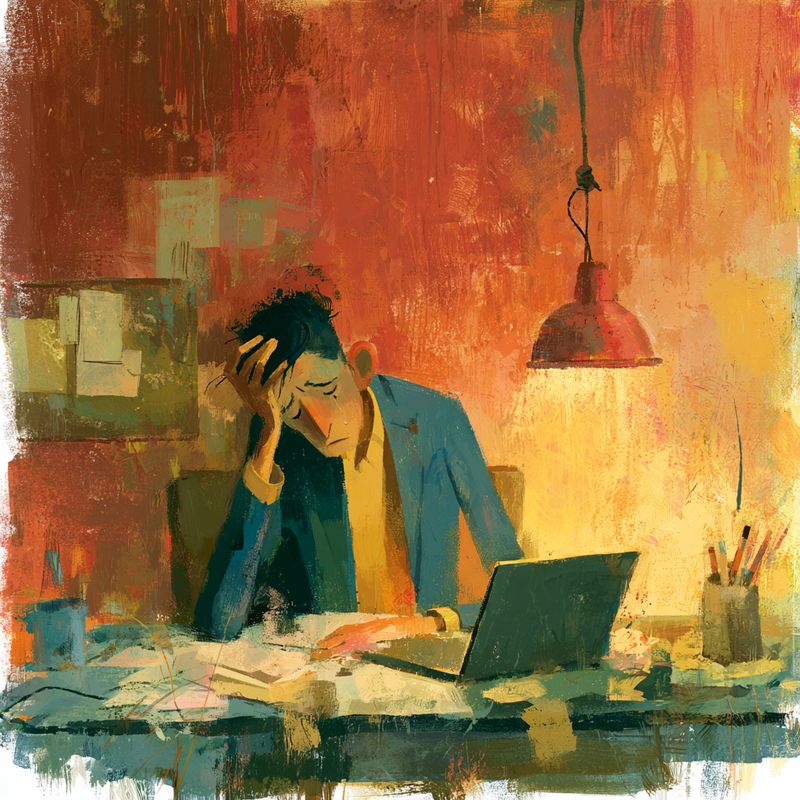
The cruelest trick anxiety plays on you at work is this: the higher the stakes, the harder it becomes to act.
If you can’t start work tasks even when your job security depends on it, you’re not lazy, undisciplined, or incompetent. Your brain is caught in a neurobiological trap where the very fear that should push you forward is actively shutting down the systems you need to begin. Understanding this isn’t an excuse. It’s a map out.
Approximately 88% of the workforce experiences stress related to job security or performance evaluation, according to the American Psychological Association’s 2021 Workplace Stress Survey. Most of them are told to just push through it. That advice ignores the science almost entirely.
Why Does Job Security Anxiety Make It Harder to Start Tasks?
Job security anxiety doesn’t just make work feel uncomfortable. It chemically alters how your brain operates. When you perceive a threat to your livelihood, your body releases cortisol and other stress hormones that were designed to help you outrun predators, not write quarterly reports.
The problem is that prefrontal cortex function, the brain region responsible for planning, initiating tasks, and regulating behavior, gets significantly impaired under this hormonal load. Research from Robert Sapolsky, professor of biology and neurology at Stanford, outlined in his book Why Zebras Don’t Get Ulcers (2004), describes how stress hormones like cortisol can impair prefrontal cortex function, making it harder to initiate tasks and make decisions, even when the consequences are serious.
This is the stress paradox in its purest form. The fear of being fired, which should logically compel you to work, biochemically reduces your capacity to do so.
Cortisol levels can remain elevated for hours after a stressful trigger, according to Sapolsky’s research on stress hormones and cognition. That means a difficult conversation with your manager in the morning can leave your brain compromised for the rest of the workday.
What’s Actually Happening in Your Brain During Task Paralysis at Work?
Task paralysis at work isn’t a character flaw. It’s a predictable output of a brain under siege by its own threat-detection system.
Sian Beilock, cognitive scientist and president of Dartmouth College, explains in her book Choke: What the Secrets of the Brain Reveal About Getting It Right When You Have To (2010) that performance anxiety consumes working memory resources, leaving less mental capacity to focus on and initiate the actual task at hand. Working memory is the mental workspace where you hold information, sequence steps, and decide what to do next. Anxiety fills that space with worst-case scenarios instead.
Beilock’s research on performance under pressure, also cited in Choke, goes further: when people feel their performance is being evaluated or stakes are high, the anxiety itself becomes the primary cognitive load, preventing task engagement. Your brain is already fully occupied processing the threat. There’s simply no bandwidth left to open the document.
Sapolsky’s Stanford lectures on stress and decision-making add another layer. When stressed, the brain shifts from goal-directed behavior to habit-based behavior, which can lead to avoidance patterns. Checking email obsessively, reorganising your desktop, scrolling through Slack without reading anything. These aren’t distractions you chose. They’re the brain defaulting to low-demand habits because higher-order task initiation has gone offline.
Researcher Stafford Lightman, whose work appears in Psychoneuroendocrinology, found that chronic stress dysregulates the HPA axis, impairing motivation and behavioral initiation by affecting dopamine and norepinephrine systems. In plain terms: prolonged job security anxiety doesn’t just affect one bad day. It rewires the motivational circuitry over time.
Does Willpower Fix Starting Work When Stressed?
This is where most workplace productivity advice fails people completely. The standard prescription for someone who can’t start work tasks is essentially: try harder. Set a timer. Just begin. These are willpower-based solutions applied to a physiological problem.
Kelly McGonigal, health psychologist at Stanford and author of The Willpower Instinct (2011), explains that the stress response itself can undermine willpower by depleting glucose in the prefrontal cortex, making self-control and task initiation harder. Willpower isn’t infinite. It runs on biological fuel. And stress burns through that fuel before you’ve typed a single word.
Asking someone experiencing fear of being fired to simply apply more self-discipline is roughly equivalent to telling someone with a broken leg to walk it off. The mechanism needed to execute the advice is the same mechanism that’s been compromised.
This is probably the most under-acknowledged problem in corporate productivity culture. The entire framework of self-discipline and motivation assumes a baseline neurological state that anxiety actively destroys.
According to research published by Piers Steel in Psychological Bulletin (2007), 20 to 25% of adults are chronic procrastinators, with task initiation and avoidance being the primary manifestations. That number almost certainly undercounts people whose avoidance is specifically triggered by high-stakes professional situations rather than low-interest tasks.
How Can Stress Reappraisal Help You Start Working Again?
If willpower fails under job security anxiety, the intervention has to work at the level of the stress response itself, not on top of it.
Stress reappraisal is one of the most research-supported tools for doing exactly this. Instead of trying to suppress anxiety or power through it, reappraisal involves changing the meaning you assign to the physiological stress response.
McGonigal, in The Upside of Stress (2015), argues that how you think about stress matters: viewing stress as enhancing rather than debilitating can improve performance and reduce avoidance behaviors. The physical sensations of anxiety (racing heart, tightened chest, heightened alertness) are nearly identical to the sensations of excitement. Your interpretation determines which direction the response goes.
Practically, this means replacing “I’m terrified I’ll fail this” with “my body is preparing me to perform.” This isn’t toxic positivity. It’s a documented neurological lever. Studies cited by McGonigal show that people who reframe stress as functional show lower cortisol reactivity and better cognitive performance under pressure.
This approach bypasses the willpower problem entirely. You’re not asking a depleted prefrontal cortex to force action. You’re reducing the cortisol load so that the prefrontal cortex can function again.
What Physiological Strategies Reduce Task Paralysis Fast?
Reappraisal works well as a medium-term habit, but starting work when stressed often requires something more immediate. Physiological regulation strategies can bring cortisol levels down quickly enough to restore basic task-initiation capacity.
Extended exhale breathing (inhaling for four counts, exhaling for six to eight) activates the parasympathetic nervous system, counteracting the cortisol-driven stress state within minutes. This isn’t a wellness cliché. It’s basic autonomic neuroscience: the exhale phase of breathing is directly linked to vagal nerve activation and heart rate deceleration.
Physical movement, even a two-minute walk, helps metabolise circulating stress hormones that are impairing prefrontal function. Sapolsky’s research consistently points to physical activity as one of the most effective biological reset mechanisms available.
Task decomposition also matters here, though not for the reason most productivity guides suggest. Breaking a task into smaller steps isn’t primarily about reducing overwhelm psychologically. It reduces the working memory load required to initiate. When Beilock identifies anxiety as consuming working memory, the fix is to require less working memory to begin. One sentence. One calculation. One subject line. The smallest possible unit of action.
Time Is Luck is built around this principle: reducing the cognitive cost of starting so that a compromised brain can still find a way in.
How Do You Break the Fear-Avoidance Loop Long Term?
Short-term regulation strategies are essential, but fear of being fired creates a loop that rebuilds itself if the underlying appraisal pattern doesn’t change.
The loop works like this: anxiety about performance triggers avoidance; avoidance increases the actual risk of underperforming; heightened risk increases anxiety. Each cycle reinforces the next.
Breaking this loop requires two things working together. First, physiological regulation (breathing, movement, task decomposition) to restore short-term function. Second, a gradual rebuilding of what psychologists call self-efficacy: the belief that you’re capable of executing the task even under pressure.
Self-efficacy doesn’t rebuild through positive thinking. It rebuilds through small, completed actions. Each time you start and finish even a minor task under stressed conditions, you generate direct evidence against the catastrophic narrative your anxiety is running. Over time, the threat appraisal softens because the evidence doesn’t support it.
This is slow. It requires consistency, not heroic effort. But it’s the only approach that addresses both the neurobiological mechanism and the cognitive pattern driving it.
FAQ
Why can’t I start work tasks even when I know my job depends on it?
High-stakes situations trigger cortisol release, which impairs the prefrontal cortex, the brain region responsible for initiating tasks. According to Robert Sapolsky’s research in Why Zebras Don’t Get Ulcers, this impairment can persist for hours. The fear of consequences doesn’t override this biological effect. It causes it.
Is task paralysis at work a sign of laziness?
No. Cognitive scientist Sian Beilock’s research in Choke (2010) shows that performance anxiety consumes working memory, leaving insufficient cognitive resources to begin tasks. Task paralysis is a measurable neurological state, not a personality trait.
Does stress about job security actually make performance worse?
Yes, and that’s the paradox. The APA’s 2021 Workplace Stress Survey found that roughly 88% of workers experience job security or performance-related stress. Chronic exposure to this stress dysregulates dopamine and norepinephrine systems, according to Stafford Lightman’s neuroendocrinology research, reducing motivation and behavioural initiation over time.
What’s the fastest way to reduce task paralysis when I need to start working now?
Extended exhale breathing (four counts in, six to eight out) activates the parasympathetic nervous system and can reduce acute cortisol effects within minutes. Pairing this with the smallest possible task unit, one sentence, one line, one click, reduces the working memory demand enough for an anxious brain to begin.
Can reframing how I think about stress actually help me start work?
Yes, according to Kelly McGonigal in The Upside of Stress (2015). Viewing stress as a performance-enhancing signal rather than a threat reduces cortisol reactivity and improves cognitive function under pressure. This isn’t about denying the stress. It’s about changing the meaning assigned to it, which changes the neurochemical response that follows.