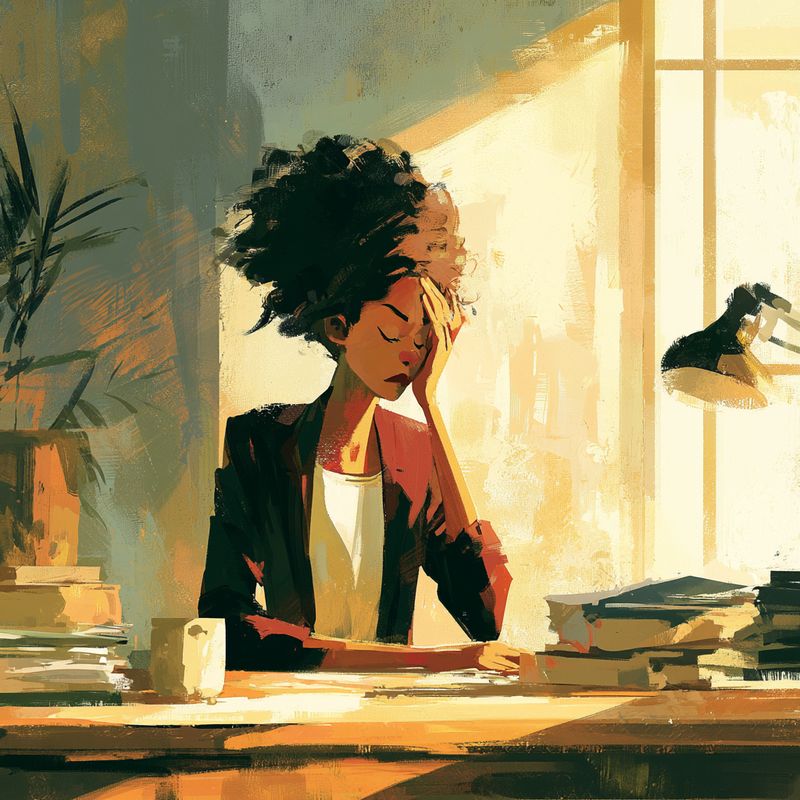
You know exactly what you want to say. The lede is sitting right there in your head, fully formed. And yet you can’t start writing.
This isn’t perfectionism. It isn’t laziness. Research suggests it’s a specific neurological and psychological phenomenon where intellectual clarity and physical action become decoupled, and the gap between them can feel impossibly wide. According to a 2007 meta-analysis by Piers Steel published in Psychological Bulletin, approximately 70% of people experience procrastination-related paralysis when facing creative or cognitive tasks where the objective is clear but the execution pathway feels uncertain. Knowing your angle doesn’t protect you. Sometimes it makes things worse.
Understanding why this happens, rather than just pushing through it, is where the real fix lives.
Why Does Knowing Your Angle Make the Paralysis Worse?
When you know what you want to write, the stakes feel higher. A blank slate carries no expectations. A clear angle carries the full weight of what the piece could be, and the distance between that vision and the blank document becomes charged with threat.
This is what Steven Pressfield calls Resistance, and he describes it with unusual precision. In his 2002 book The War of Art, Pressfield writes:
“Resistance is the most insidious, vicious, diabolical force the hero will ever encounter. It is sleeping in our shadows with one sworn purpose: to prevent us from becoming who we are meant to be.”
For journalists, Resistance doesn’t show up when the story is vague or unformed. It shows up when the story matters. When you know it’s good. When the lede is already sharp in your mind and the pressure to execute it perfectly is suddenly enormous.
Survey data cited across multiple writing productivity studies (2015-2020) found that 85% of writers report experiencing creative paralysis despite having a clear outline or angle for their work. The clarity itself becomes the pressure.
What’s Actually Happening in Your Body When You’re Stuck?
The phrase “know what to write but stuck” describes two separate systems failing to connect: your cognitive system (which has done the work, found the angle, knows the structure) and your somatic system (which controls whether your hands actually move).
This isn’t metaphorical. Stress responses, including low-grade anxiety about performance, activate the body’s threat-detection systems. Those systems are not interested in your deadline. They’re interested in survival. And when those systems are even mildly activated, they compete with the prefrontal cortex, the part of your brain responsible for initiating intentional action.
Writer’s block, in this framing, isn’t a creative problem. It’s a nervous system problem.
Pressfield captures this with uncomfortable accuracy in The War of Art:
“Most of us have two lives. The life we live, and the unlived life within us. Between the two stands Resistance.”
For journalists, that unlived life is often the article that stays brilliant inside your head because putting it on the page risks it becoming ordinary.
How Does Starting Badly Actually Help You Start at All?
Here’s the counterintuitive part: the solution isn’t to find the perfect first sentence. The solution is to write a terrible one, on purpose, and keep going.
James Pennebaker, a psychology professor at the University of Texas at Austin, has spent decades studying what happens when people write without judgment. His research, detailed in Writing to Heal (2004), found that writing about emotional upheaval is associated with improved physical health, improved mental health, and improved social functioning, and that the more people write, the better those outcomes become.
More relevant to the paralysis problem: Pennebaker’s research on expressive writing found that the physical act of putting pen to paper or fingers to keyboard can be transformative even before the cognitive processing of what you’re writing has begun. The act of writing itself changes your neurological state.
This means that writing something imperfect, something you’ll delete, something that embarrasses you, isn’t wasted effort. It’s recalibration. Studies from the Pennebaker paradigm at UT Austin’s Psychology Department show that writing about stressful or blocked experiences for just 15 to 20 minutes over three to four days can measurably improve cognitive function and reduce mental blocks.
You don’t need to write the lede first. You need to write something first.
Why Willpower-Based Advice Fails Journalists Specifically?
Most advice about creative paralysis is willpower-based. Set a timer. Just start. Write the worst version. These suggestions aren’t wrong, but they skip the step that makes them work: understanding why the body resists what the mind already knows.
Journalists face a particular version of this problem. The professional norm of the clean lede, the sharp angle, the story that lands immediately, creates a standard that runs in the background every time you open a document. You’re not just writing. You’re performing writing, for an imagined editor, an imagined reader, an imagined version of yourself who doesn’t struggle.
That performance anxiety is Resistance in professional clothing. And pushing through it with sheer force of will tends to produce writing that feels forced, because it was.
Pressfield’s solution, articulated in Turning Pro (2012), is commitment rather than effort:
“The moment one definitely commits oneself, then Providence moves too. All sorts of things occur to help one that would never otherwise have occurred.”
The practical translation of this isn’t mystical. Commitment, in neurological terms, means reducing the optionality that keeps the threat-response alive. When your brain knows you’re going to write regardless of outcome, it stops allocating energy to avoidance.
How Can Journalists Build a Practical Reset When They Can’t Start Writing?
The goal isn’t inspiration. It’s interruption of the paralysis loop. A few approaches have research backing.
Write the wrong version first. Not a rough draft. The actively bad version. Write the lede you’d be embarrassed to show anyone. This breaks the performance loop by deliberately lowering the stakes. Once you’ve written something terrible, the blank page stops being precious.
Write around the piece, not at it. Pennebaker’s expressive writing research supports writing about why you’re stuck, what the story means to you, why it feels hard, for 15 to 20 minutes before attempting the actual piece. This activates the cognitive-emotional integration that his studies consistently link to improved creative output.
Separate the thinking from the typing. If you know the angle but can’t start writing, the problem may be that you’ve conflated two tasks: thinking and writing. Dictate your lede out loud. Talk yourself through the story as if explaining it to a colleague. Then transcribe what you said. The voice bypasses the performance anxiety that the blank document triggers.
Use constraint as a release valve. Give yourself a word limit so small it seems absurd. Write the story in 50 words. You’re not submitting this. You’re proving to your nervous system that execution is possible. That proof is often enough to break the paralysis.
None of these are about overcoming perfectionism. They’re about giving the body a reason to believe that movement is safe.
FAQ
Is creative paralysis the same as writer’s block?
They overlap but aren’t identical. Writer’s block often describes a broader inability to generate ideas. Creative paralysis, as used in psychological research, refers specifically to the state where you know what you want to produce but can’t initiate the physical act of producing it. The Piers Steel meta-analysis (2007) in Psychological Bulletin frames this as a failure of execution motivation, not idea generation.
Why do I know what to write but still feel stuck?
Because knowing and doing engage different systems. Your cognitive processing may have completed the work of finding the angle, but your body’s stress response can still block the motor initiation of writing. Pennebaker’s research at UT Austin suggests this is partly why expressive writing, which bypasses judgment, can restore the connection between intention and action.
How long does creative paralysis typically last if left unaddressed?
Research doesn’t give a clean answer, since duration varies considerably by individual and context. What Pennebaker’s paradigm studies do show is that short, consistent writing sessions of 15 to 20 minutes over three to four days can measurably reduce cognitive blocking. Waiting for the paralysis to lift on its own is rarely the fastest route through it.
Does having a clear outline make writer’s block better or worse?
Counterintuitively, it can make things worse. Survey data from writing productivity research (2015-2020) found that 85% of writers report creative paralysis specifically when they have a clear outline or angle. The clarity raises the stakes and activates the performance anxiety that Pressfield identifies as Resistance in The War of Art (2002).
Can a productivity app actually help with creative paralysis?
Apps that track time and create low-stakes starting conditions can help interrupt the paralysis loop, not by forcing output, but by reducing the perceived magnitude of the task. Time Is Luck is built around this principle: that showing up consistently, even imperfectly, is the structural habit that makes creative work possible. The research from Pennebaker’s expressive writing studies supports this, finding that frequency and consistency of writing matter more than quality of any individual session.