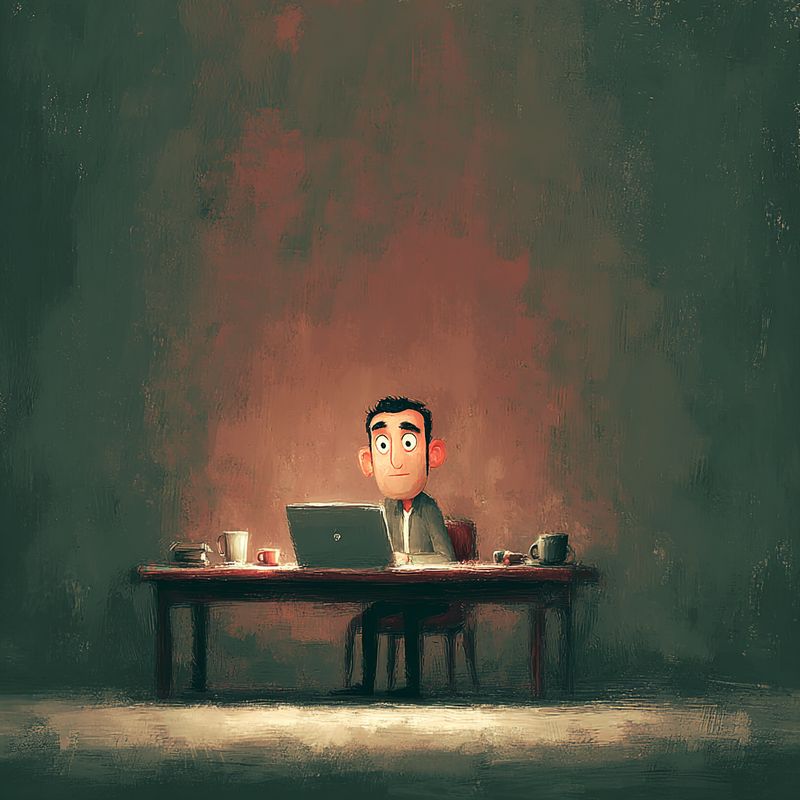
You know the exam is coming. You’ve known for two weeks. And yet you’re watching videos, reorganising your desk, doing literally anything except opening your textbook. This isn’t laziness. Your brain is doing exactly what it’s designed to do under threat — and studying isn’t on that menu.
Exam stress triggers a genuine neurological shutdown of the systems you need to learn. The procrastination you’re experiencing before exams isn’t a character flaw or a motivation problem. It’s a stress response. Research confirms this, neuroscientists have mapped it, and once you understand what’s actually happening in your brain, the path forward becomes much clearer.
Why Does Exam Stress Make It Impossible to Start Studying?
When you feel the pressure of an upcoming test, your brain reads that anxiety as danger. Not metaphorical danger. Actual, physical, survival-level danger. The amygdala (the brain’s alarm system) fires up, and your body floods with cortisol and adrenaline. These are the same hormones that help you sprint away from a threat.
The problem is that sprinting and studying use completely different brain systems.
As Stanford neurobiologist Robert Sapolsky explains in his lectures and in his book Why Zebras Don’t Get Ulcers (2004), when you’re stressed, your prefrontal cortex — the rational, planning part of your brain — effectively goes offline. Your amygdala takes over, triggering fight-or-flight responses that make it harder to think clearly and plan ahead.
Studying requires your prefrontal cortex. Planning a revision schedule requires your prefrontal cortex. Deciding where to start requires your prefrontal cortex. Exam stress shuts down the exact equipment you need to deal with exam stress. That’s the trap.
Research backs this up starkly. Students with high test anxiety show reduced activation in the prefrontal cortex and increased amygdala activity during high-stakes cognitive tasks (Beilock et al., neuroimaging research on performance anxiety). Approximately 60% of students experience significant exam anxiety that interferes with their ability to prepare and perform, according to a meta-analysis of test anxiety research across multiple institutions.
You’re not broken. You’re outnumbered by your own stress hormones.
What Happens to Your Memory and Focus Under Pressure?
Even if you manage to sit down with your notes, exam pressure doesn’t just make you feel anxious. It actively degrades your cognitive performance in measurable ways.
Sian Beilock, a cognitive scientist at the University of Chicago and author of Choke: What the Secrets of the Brain Reveal About Getting It Right When You Have To (2010), explains that when we’re under pressure, working memory becomes constrained. Working memory is the mental workspace you use to hold and manipulate information — and it’s essential for complex tasks like studying that require connecting multiple ideas at once.
Beilock’s research shows that performance anxiety doesn’t just make us feel bad. It actually changes how our brains function, particularly in areas responsible for attention and working memory.
The numbers are striking. Students under acute stress show a 35% reduction in working memory capacity compared to their baseline (cognitive psychology research on stress-induced working memory impairment, multiple studies from the 2000s to 2010s). That’s not a slight dip. That’s trying to study with a third of your mental workspace simply unavailable.
This is why “just push through it” is such bad advice for students who can’t start studying. Willpower-based strategies (just sit down, just open the book, just force yourself) ask you to override a neurological state using the very brain systems that stress has already compromised.
You can’t think your way out of a panic response using a panicking brain.
Why Does Procrastinating Before Exams Feel Like Such a Relief?
Here’s the part that makes exam procrastination so persistent: avoidance actually works. In the short term.
Kelly McGonigal, a health psychologist at Stanford and author of The Willpower Instinct (2011), describes a phenomenon called “present bias.” Stress makes us hyperfocused on the immediate feeling of anxiety rather than the future consequence of not studying. Procrastination feels like relief rather than avoidance, because in the moment, it genuinely reduces the anxiety signal.
Open YouTube. Anxiety drops. Close the textbook. Tension releases. Your brain registers this as: avoidance worked. Repeat.
According to research published in Psychological Bulletin by Piers Steel (2007), approximately 50% of college and university students report procrastinating on academic tasks, with exam-related procrastination being one of the most common forms. Half of all students are caught in this loop.
McGonigal also notes in The Upside of Stress (2015) that your mindset about stress matters tremendously. When you view stress as debilitating rather than enhancing, it actually impairs your performance and increases avoidance behaviours. Which creates a painful irony: believing that your anxiety is evidence you can’t cope makes it harder to cope.
The cycle looks like this. Exam pressure builds. Anxiety signals danger. Brain avoids the danger source (studying). Relief is temporary. Guilt adds to anxiety. The pile gets bigger. Repeat.
Understanding this cycle doesn’t automatically break it. But it does mean you can stop wasting energy on self-blame and start working with what’s actually happening.
How Can High School Students Actually Break the Freeze? 4 Steps That Work With Your Brain
The four steps below aren’t motivational tips. They’re strategies designed specifically for a brain in stress mode, grounded in what the neuroscience actually says about breaking the freeze.
Step 1: Regulate Before You Study (Even for 5 Minutes)
You can’t study effectively while your amygdala is running the show. The fastest way to bring your prefrontal cortex back online is to physically reduce your stress response first.
Slow, controlled breathing (inhale for 4 counts, exhale for 6) activates the parasympathetic nervous system and reduces cortisol. Even a 5-minute walk achieves the same thing. This isn’t procrastinating. This is neurological preparation.
Sapolsky’s research in Behave: The Biology of Humans at Our Best and Worst (2017) confirms that stress hormones like cortisol and adrenaline shift your brain into immediate survival mode, making long-term planning and sustained focus nearly impossible. You have to lower those hormone levels before studying can work.
Step 2: Shrink the Task Until It Feels Physically Small
Your stressed brain catastrophises. “Study for biology exam” triggers the same threat response as the exam itself. “Read three paragraphs about cell division” does not.
Reduce the task until it barely feels like a task. Not one hour of revision. One page. Not the whole subject. One concept. The goal isn’t to study efficiently in this moment. The goal is to get your brain to stop reading the task as a threat.
Once you’ve started, the anxiety signal drops. Momentum is easier to sustain than it is to create from nothing.
Step 3: Separate the Work Time from the Outcome
That feeling that studying might not even be enough is one of the biggest contributors to test anxiety and the freeze response. It’s a thought spiral. “What if I study and still fail?”
Astronaut Chris Hadfield, writing in An Astronaut’s Guide to Life on Earth (2013), describes how preparation and visualisation help the brain stay in control when pressure hits. Without those tools, the nervous system defaults to panic and shutdown.
The practical version: commit to a study block (say, 20 minutes) where your only job is to do the work, not to guarantee the outcome. You’re not studying to definitely pass. You’re studying to do the work. That cognitive reframe reduces the stakes enough for your prefrontal cortex to re-engage.
Step 4: Name the Stress Out Loud (or on Paper)
This one sounds too simple to work. It isn’t.
Research shows that labelling emotions (“I feel anxious about this exam”) reduces amygdala activation. It’s called affect labelling, and it works precisely because naming a threat shifts processing from the reactive amygdala toward the prefrontal cortex.
Write down: “I’m feeling anxious because the exam is in four days and I haven’t started.” That act alone begins to transfer control back to the thinking brain. You’re not suppressing the stress. You’re processing it, which is a very different thing.
FAQ
Q: Is it normal to freeze and procrastinate even when you know an exam is important?
A: Completely normal. Research by Piers Steel (2007) found that approximately 50% of students procrastinate on academic tasks, with exam procrastination among the most common forms. Knowing something is important doesn’t prevent the stress response from triggering avoidance. It can actually intensify it.
Q: Why do I feel like studying is impossible even when I sit down to try?
A: Exam stress reduces your working memory capacity by up to 35%, according to cognitive psychology research on stress-induced impairment. Sian Beilock’s work in Choke (2010) shows that performance anxiety physically changes how your brain functions, particularly in attention and memory. You’re not imagining the difficulty. The cognitive resource is genuinely diminished.
Q: Does test anxiety get worse if you avoid studying?
A: Yes. Avoidance gives short-term relief but increases anxiety over time because the underlying threat (the exam) doesn’t go away. Kelly McGonigal’s research on stress and decision-making, discussed in The Willpower Instinct (2011), explains how present bias keeps the avoidance cycle going. The longer the avoidance, the more loaded the task becomes.
Q: What’s the fastest way to get out of the study freeze?
A: The fastest intervention is physiological, not motivational. Five minutes of slow breathing or light movement lowers cortisol levels enough to bring the prefrontal cortex back into function. From there, starting with an extremely small, specific task (one paragraph, one flashcard) prevents the amygdala from re-triggering. Don’t start with the hardest or most important topic.
Q: Can an app help with procrastinating before exams?
A: Tools that make task-starting frictionless help a stressed brain that struggles with initiation. Apps like Time Is Luck are designed to reduce the decision-making overhead that exam stress makes so costly. The less your brain has to decide before starting, the less opportunity there is for avoidance to kick in.