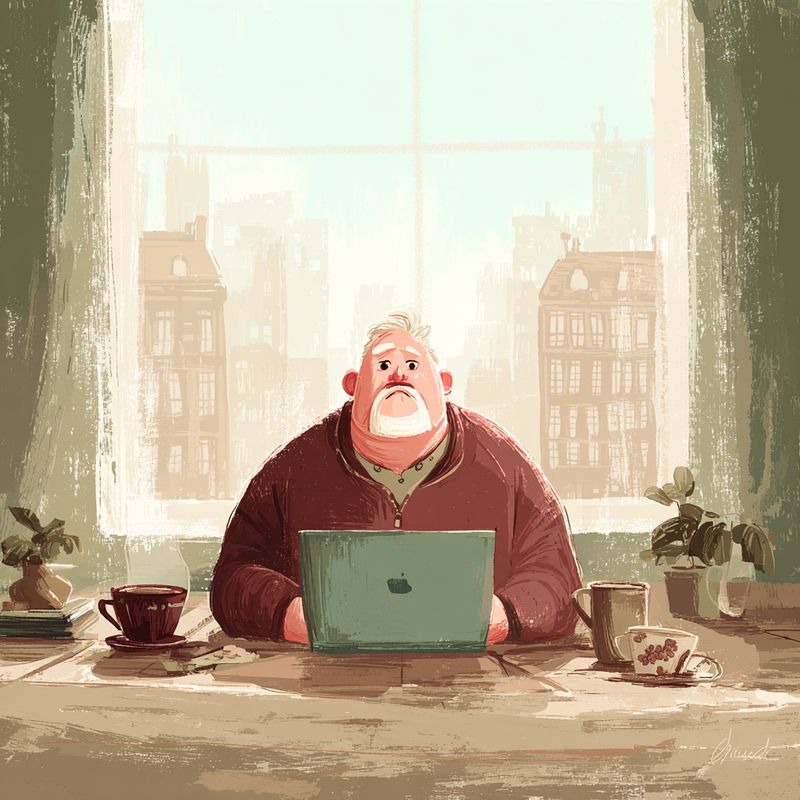
If you’re self-employed and you keep delaying the work that would actually grow your business, your brain isn’t broken. It’s doing exactly what brains do under financial threat.
Unstable income procrastination is one of the most misunderstood patterns in freelance life. Research shows that procrastination is 2-3 times more prevalent among people facing uncertain or unstable employment situations (research on job insecurity and procrastination behavior, 2018). For freelancers, that’s not a character flaw. It’s a predictable neurological response. Understanding the mechanism is the first step to breaking it.
Why Does Income Uncertainty Cause Procrastination in the First Place?
When income feels unpredictable, your brain registers it as a survival threat, not a scheduling inconvenience. That threat response triggers avoidance. And avoidance, over time, hardens into the kind of procrastination that stalls entire careers.
Neuroscientist Dean Burnett, writing in his 2016 book Idiot Brain, explains that the brain’s threat detection system is hypersensitive to uncertainty. When income is unstable, the brain perceives this as a genuine threat, triggering avoidance behaviors like procrastination as a coping mechanism.
This matters because it reframes the problem completely. The feast or famine freelancer who can’t seem to start the next proposal isn’t lazy. They’re caught in a loop where the very act of starting feels dangerous, because starting means confronting the uncertainty head-on.
According to Piers Steel’s meta-analysis published in Psychological Bulletin (2007), 20-25% of the general population identifies as chronic procrastinators. But among people navigating uncertain work schedules, that number climbs significantly. The American Psychological Association’s 2019 survey on freelancer wellbeing found that up to 40% of self-employed workers report anxiety related to income instability. Anxiety and procrastination, it turns out, are close cousins.
What’s Actually Happening in Your Brain When Work Feels Unpredictable?
The connection between uncertain work schedule procrastination and the brain’s threat response runs deeper than most productivity advice acknowledges. When your nervous system detects financial instability, it activates the same fear circuitry that evolved to protect you from physical danger.
Judson Brewer, a psychiatrist and mindfulness researcher at Brown University, describes the mechanism clearly in his 2017 book The Craving Mind: procrastination is a way we regulate emotion. When we’re anxious or uncertain, we seek relief by doing something else. But this creates a habit loop that reinforces the procrastination behavior itself.
So the freelancer who opens their laptop, feels the weight of an uncertain pipeline, and then drifts to social media isn’t making a conscious choice. They’re following a deeply grooved neurological path toward short-term emotional relief.
Organizational psychologist Adam Grant, drawing on Wharton research into motivation and procrastination, puts it this way: when people feel uncertain about their ability to succeed, they’re more likely to delay taking action, especially when the stakes feel high. For someone whose self employed job security depends entirely on their own output, the stakes rarely feel higher.
The cruel irony is that avoidance makes the anxiety worse. Grant also notes, based on his research and explored in his 2016 book Originals, that procrastination may reduce anxiety in the short term but increases it in the long term. The feast or famine cycle accelerates precisely because procrastination during the famine phase prevents the work that would create the next feast.
How Can Freelancers Interrupt the Procrastination Habit Loop?
Mindfulness research offers one of the more evidence-based entry points here. Brewer’s work at Brown University suggests that awareness without judgment is key. When freelancers can observe their anxiety about income uncertainty without trying to fight it or escape it through procrastination, they can interrupt the habit loop before it takes hold.
This isn’t about meditation retreats. It’s about a 60-second pause before the avoidance behavior kicks in. Noticing the discomfort, naming it as financial anxiety rather than calling yourself undisciplined, and then choosing a small, concrete action.
Small actions matter disproportionately here. The brain’s threat response shrinks when you generate evidence of forward momentum. One email sent. One paragraph drafted. One invoice followed up. These micro-completions signal safety to a nervous system that’s been scanning for danger.
Researchers studying job insecurity and behavior also point to the importance of separating identity from income fluctuation. When your sense of professional worth rises and falls with your bank balance, every slow month becomes an existential threat. Decoupling the two, cognitively and practically, reduces the intensity of the threat signal.
4 Practical Ways to Start Projects When Income Feels Unstable
Here are four approaches grounded in the research above, designed specifically for the realities of freelance and self-employed work.
1. Name the Anxiety Before You Open the Work
Brewer’s habit loop research suggests that labeling the emotion disrupts its automatic power. Before you sit down to work, take thirty seconds to acknowledge what you’re actually feeling. “I’m anxious about money and that’s making it hard to start.” That’s not weakness. That’s neuroscience working in your favor.
Naming the emotion activates the prefrontal cortex, the rational decision-making part of the brain, and reduces the amygdala’s grip on your behavior. You’re not suppressing the anxiety. You’re processing it just enough to act anyway.
2. Shrink the Start to an Almost-Embarrassing Size
Unstable income procrastination often attaches to the scale of the task. When a project feels like it needs to generate revenue immediately, starting it feels enormous. So make the starting action so small it barely counts.
Open the document and write one sentence. Send one message. Sketch one rough structure. Grant’s research on productive procrastination suggests that the goal isn’t to eliminate the hesitation entirely but to work with the brain’s need for manageable entry points. Once momentum starts, it tends to continue.
3. Build a “Floor” Routine That Doesn’t Depend on Motivation
One of the most reliable findings in procrastination research is that motivation follows action, not the other way around. For self employed job security, this means building a minimum daily work routine that runs regardless of how uncertain the pipeline feels.
This could be as simple as: two hours of client-facing work before checking finances or messages. The floor routine removes the daily decision about whether to start. It becomes the default. And defaults are more powerful than intentions, especially when anxiety is high.
4. Reframe Uncertainty as Information, Not Threat
This is the contrarian take that the productivity industry tends to skip: income uncertainty isn’t always a problem to solve. Sometimes it’s data to act on. The feast or famine freelancer who’s in a famine phase has specific information about what needs attention, whether that’s outreach, pricing, or repositioning.
Reframing uncertainty as actionable information shifts the brain from threat mode toward problem-solving mode. Research on cognitive reappraisal consistently shows that changing the meaning you assign to a stressor changes the physiological response it generates. You’re not pretending the instability doesn’t exist. You’re choosing to engage with it rather than avoid it.
Does Understanding the Neuroscience Actually Change Behavior?
Knowing why you procrastinate doesn’t automatically stop it. But it does change the relationship with the behavior, and that matters more than most productivity frameworks acknowledge.
When a freelancer understands that their uncertain work schedule procrastination is a predictable brain response rather than a personal failing, self-criticism drops. And self-criticism, research consistently shows, makes procrastination worse, not better. Shame is not a productivity tool.
Brewer’s mindfulness research supports this directly: the non-judgmental observation of anxiety, rather than the fight against it, is what creates space for different choices. You’re not trying to eliminate the discomfort of financial uncertainty. You’re learning to act alongside it.
Grant’s framing adds another layer: moderate uncertainty, engaged with rather than avoided, can enhance creative thinking. The freelancer who learns to sit with unpredictability without shutting down may actually develop a higher tolerance for the ambiguity that creative and entrepreneurial work requires.
The feast or famine cycle has a neurological engine. But it also has an off switch, and it’s located in understanding, not willpower.
FAQ
Is procrastination more common among freelancers than salaried employees?
Research suggests yes. A 2018 study on job insecurity and procrastination found procrastination is 2-3 times more prevalent among people in uncertain or unstable employment situations. Freelancers face structural uncertainty that salaried workers don’t, which means the brain’s threat response fires more frequently and avoidance behaviors become more entrenched over time.
Why do I procrastinate most during slow work periods when I have the most time?
This is one of the more disorienting aspects of unstable income procrastination. Slow periods increase financial anxiety, which intensifies the brain’s threat response, which makes starting feel harder. According to Judson Brewer’s research in The Craving Mind (2017), the habit loop of anxiety followed by avoidance gets reinforced during exactly these periods. More time doesn’t reduce procrastination if the underlying anxiety isn’t addressed.
Can mindfulness really help with procrastination caused by financial stress?
The evidence is reasonably strong. Brewer’s work at Brown University found that non-judgmental awareness of anxiety disrupts the automatic habit loop that leads to avoidance. It won’t eliminate financial stress, but it can create enough of a pause between the anxiety and the avoidance behavior to allow a different choice. Even brief, consistent mindfulness practice appears to reduce procrastination frequency over time.
What’s the difference between productive procrastination and avoidance?
Adam Grant’s Wharton research on productive procrastination suggests that brief delays on creative tasks can allow for better idea generation, as the mind makes unexpected connections during the incubation period. Avoidance, by contrast, is open-ended, emotionally driven, and tends to increase anxiety rather than reduce it. The practical difference: productive procrastination has a natural end point and produces better output. Avoidance just delays the discomfort.
How does the Time Is Luck app help with income-related procrastination?
Time Is Luck is designed to help self-employed and freelance workers build consistent momentum regardless of how their income pipeline looks on any given day. By focusing on time as the resource within your control (rather than income, which isn’t), the app supports the kind of floor routine and micro-completion habits that the research above identifies as most effective for breaking the feast or famine cycle.