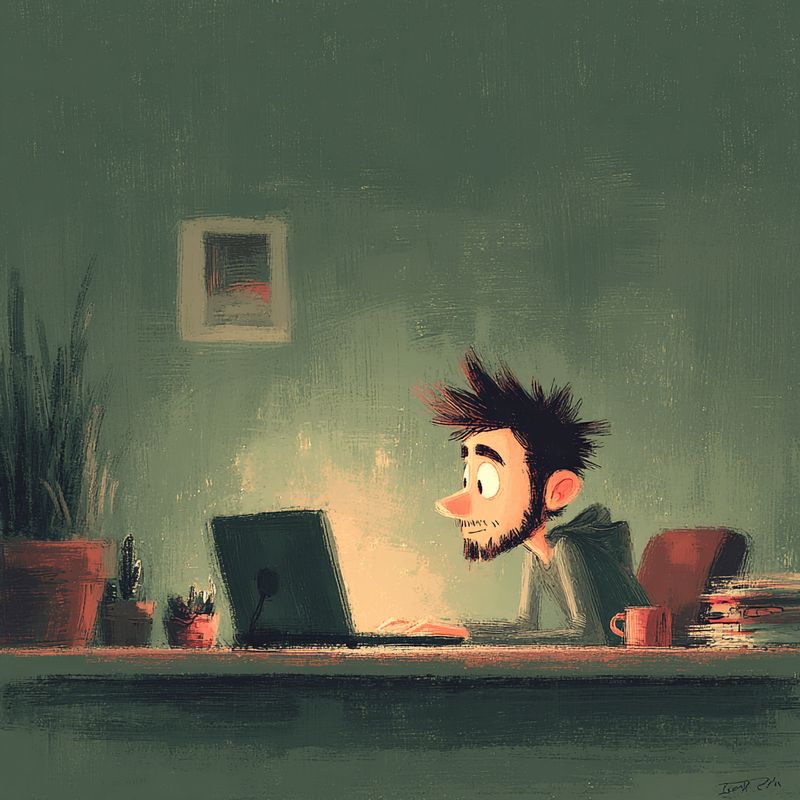
The dream was no boss. No arbitrary deadlines. No one micromanaging your hours. And then you got exactly what you wanted, and somehow everything got harder.
Freedom and procrastination turn out to be deeply connected. Research consistently shows that self-employed workers face higher rates of burnout, chronic delay, and motivational collapse than their office-bound counterparts. Not because they’re lazy. But because the human brain wasn’t built to operate without external structure, and nobody warned them about that before they handed in their notice.
The good news: this is a solvable problem. But the solution isn’t what most productivity advice suggests.
Why does freedom cause procrastination in the first place?
Autonomy feels like relief until it doesn’t. Without a boss setting deadlines or a calendar packed with meetings, the brain has to generate its own direction constantly. That’s not liberation. That’s cognitive labour.
Researcher Jonathan Schooler, whose work on attention failures has been widely cited in psychology, found that mind-wandering increases significantly when there’s insufficient external structure. Without a boss or hard deadlines, the mind has to manufacture its own momentum, and that process is exhausting in ways people rarely anticipate.
This explains a pattern that catches so many freelancers off guard. The first weeks feel electric. Then the fog rolls in.
Neuroscientist Dean Burnett, writing in his 2018 book The Happy Brain, noted that the brain doesn’t cleanly distinguish between “I have no boss” and “I have total responsibility for everything.” Both states can trigger anxiety. Freedom without structure can activate the same stress responses as situations we’d usually call oppressive.
So the brain, confronted with total autonomy, doesn’t exhale. It panics quietly. And then it procrastinates.
Is this really about procrastination, or something deeper?
Most people frame independence procrastination as a discipline failure. That framing is both common and wrong.
Organisational psychologist Adam Grant, drawing on Wharton research into procrastination and emotion regulation, has argued that procrastination is fundamentally an emotion management problem, not a productivity one. People procrastinate to escape negative emotions tied to a task: boredom, anxiety, self-doubt, the fear of doing something badly.
Grant’s research also challenges the stereotype of the lazy procrastinator. The people who procrastinate most aren’t less motivated. They tend to be more emotionally sensitive, more affected by boredom and uncertainty, and more reactive to the discomfort of ambiguous, high-stakes work. Freelance work is almost entirely ambiguous and high-stakes.
Neurologist Judson Brewer, in his 2017 book The Craving Mind, mapped procrastination as a habit loop: trigger, behaviour, reward. The trigger is an uncomfortable task. The behaviour is avoidance. The reward is immediate emotional relief. The brain learns this pattern fast, and it reinforces it every time it works.
This is why no-boss, no-structure procrastination is so persistent. In an office, external structure interrupts the loop. Meetings happen. A manager checks in. Consequences arrive on schedule. Without those interruptions, the loop runs unchallenged, day after day.
Research published by Piers Steel in Psychological Bulletin (2007) estimated that approximately 20 to 25 percent of adults are chronic procrastinators. Among the self-employed, the conditions for chronic procrastination are essentially baked into the working model.
What does self-employed burnout actually look like?
Burnout in traditional employment usually follows overwork. Burnout in freelance work often follows the opposite: a cycle of avoidance, guilt, catch-up sprints, and exhaustion that repeats on a loop.
Studies on self-employment and wellbeing suggest that around 46 percent of self-employed workers report higher stress and burnout compared to people in traditional employment. The causes aren’t always what you’d expect. It’s rarely the workload itself. More often, it’s the cognitive cost of managing everything without external scaffolding.
The procrastination-burnout cycle works like this: a freelancer avoids a task because it’s anxiety-inducing. Avoidance creates guilt. Guilt creates more anxiety. The task becomes emotionally larger than it actually is. Eventually, deadline pressure forces a frantic work session. The work gets done, barely, and the freelancer is depleted. Rest doesn’t fully restore them, because the guilt about the next avoided task is already accumulating.
Psychological research across multiple studies in the 2000s and 2010s has consistently linked procrastination to higher levels of stress, anxiety, and depression. For the self-employed, where the work cycle never fully resets, those outcomes compound over months and years.
Self-employed burnout doesn’t announce itself dramatically. It looks like checking email for the fourth time instead of starting the proposal. It looks like being technically available but mentally absent.
How do you architect structure when no one gives it to you?
Here’s the contrarian take worth sitting with: freedom requires more discipline than employment, not less. The freelancers who thrive aren’t the ones who successfully escape structure. They’re the ones who build it themselves, deliberately and specifically.
Judson Brewer’s research at Brown University on mindfulness and habit change offers a useful starting point. His finding: the antidote to procrastination isn’t willpower. Willpower-based advice (just start, set a timer, push through) fails people because it doesn’t address the emotional trigger underneath the avoidance. Awareness does. When you can observe the habit loop clearly and without judgment, the loop loses power.
This matters practically. Before building external structure, freelancers need to identify what they’re actually avoiding and why. Is a particular task boring? Anxiety-producing because it involves judgment? Associated with a difficult client? The emotion drives the avoidance, and generic productivity hacks don’t reach it.
Once the emotional layer is understood, the structural layer becomes more effective. Practically, this means several things:
Artificial deadlines with real stakes. Self-imposed deadlines don’t work well because the brain knows they’re fake. External accountability does. A weekly check-in with another freelancer, a paid accountability coach, or even a public commitment creates real consequences. The brain responds to those.
Time boundaries, not task lists. Open-ended days are cognitively costly. Scheduling work into fixed blocks (not “finish the report” but “work on the report from 9am to 11am”) reduces the decision fatigue that feeds procrastination.
Ritual as structure replacement. Research on implementation intentions, the “if-then” planning strategy developed by Peter Gollwitzer, shows that specific cues trigger behaviour more reliably than motivation. A consistent start ritual, the same desk, the same first action, anchors the work day in a way that willpower alone can’t.
The goal isn’t to recreate the office. It’s to give the brain enough external anchoring that it stops spending energy generating direction from scratch every morning.
Can freelancers actually fix the freedom paradox long-term?
Yes, but the shift requires reframing what freedom means.
The original vision of freelance freedom was freedom from: from bosses, from commutes, from pointless meetings. That version of freedom is real, and it’s genuinely valuable. But it’s incomplete without the other half: freedom to produce, to focus, to do the work you left employment to do.
That second kind of freedom requires constraints. Not the arbitrary ones imposed by bad managers, but self-chosen ones that match how your brain actually functions.
Adam Grant’s framing of procrastination as emotion regulation reframes the whole task. If the problem is emotional avoidance, the solution isn’t more pressure. It’s building a working environment where the emotional cost of starting is lower than the emotional cost of not starting. That’s a design problem, not a character problem.
Freelancers who build accountability systems, who schedule rest as deliberately as they schedule work, who treat their own deadlines with the same seriousness they’d give a client’s, consistently report both higher output and lower burnout.
The freedom paradox resolves when you stop treating structure as the enemy of independence, and start treating it as the infrastructure independence runs on.
FAQ
Why do freelancers procrastinate more than employees?
Freelancers operate without the external structure (deadlines, check-ins, social accountability) that regulates motivation in traditional employment. Research by Jonathan Schooler on mind-wandering shows that the brain expends significant energy generating its own direction without external cues. Combined with Adam Grant’s finding that procrastination is an emotion regulation response, the freelance environment creates near-ideal conditions for chronic avoidance.
Is self-employed burnout different from regular burnout?
It often follows a different pattern. Traditional burnout typically results from overwork. Freelance burnout frequently stems from a procrastination-guilt-sprint cycle, where avoidance creates emotional debt that compounds over time. Studies suggest around 46 percent of self-employed workers report higher stress than traditional employees, and the cause is often the cognitive burden of self-management rather than workload itself.
What’s the fastest way to break the no-boss procrastination cycle?
Judson Brewer’s research at Brown University suggests awareness is more effective than willpower. Identifying the specific emotion driving avoidance (boredom, anxiety, self-doubt) weakens the habit loop. Practically, external accountability structures, whether a peer check-in, a paid coach, or a public commitment, create real consequences that the brain responds to in ways self-imposed deadlines don’t.
Does having total freedom actually make procrastination worse?
For most people, yes. Dean Burnett’s neuroscience research notes that total autonomy can trigger anxiety rather than relief, because the brain interprets “no external structure” as “total personal responsibility for outcomes.” Piers Steel’s meta-analysis in Psychological Bulletin (2007) found chronic procrastination affects 20 to 25 percent of adults, and the conditions of self-employment (ambiguous tasks, self-set deadlines, social isolation) correlate closely with procrastination risk factors.
How is Time Is Luck different from other productivity apps for freelancers?
Time Is Luck is built around the psychological reality of procrastination rather than generic task management. Instead of adding more to-do lists, it focuses on helping self-employed people understand their avoidance patterns and build accountability structures that actually match how motivation works without a boss.