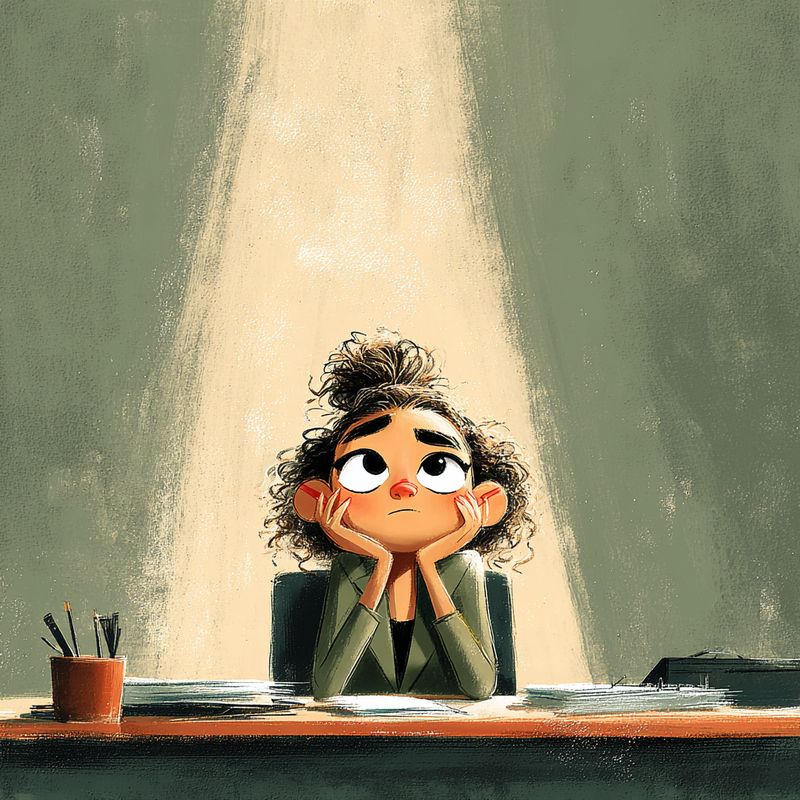
Self-doubt doesn’t show up wearing a villain’s mask. It shows up wearing the respectable, reasonable face of high standards.
That’s the core problem. When self doubt stops creative work, it rarely announces itself as fear. It announces itself as taste, as craft, as “not quite ready yet.” Research on perfectionism and procrastination consistently shows that the most creative people aren’t immune to this pattern. They’re often its most sophisticated victims. According to a 2007 meta-analysis published in Psychological Bulletin by Piers Steel, somewhere between 25% and 50% of people report chronic procrastination, and the strongest predictor isn’t laziness. It’s fear of evaluation.
The work doesn’t stay unfinished because it isn’t good enough. It stays unfinished because finished things can be judged.
Why Does Self-Doubt Disguise Itself as High Standards?
Perfectionism feels virtuous because, in small doses, caring about quality genuinely is. The psychological sleight of hand happens when “I want this to be good” quietly becomes “I can’t release this until it’s safe.” Safe from criticism. Safe from rejection. Safe from confirming your worst fears about your own ability.
In The Gifts of Imperfection (2010), researcher Brené Brown draws the distinction clearly:
“Perfectionism is not the same thing as striving to be our best. Perfectionism is the belief that if we live perfectly, look perfectly, and act perfectly, we can minimize or avoid the pain of blame, judgment, and shame.”
This reframe matters enormously for anyone struggling with self doubt and creative work. Striving for excellence is outward-facing: it asks “how can this serve the audience?” Perfectionism is inward-facing: it asks “how can I avoid being hurt?”
Neurologically, this makes sense. As neuroscientist Dean Burnett explains in Idiot Brain (2016), the brain’s self-doubt mechanisms evolved to keep humans safe from social rejection and physical risk. In ancestral environments, being judged and cast out by the group carried real survival costs. The problem is that a brain designed to protect you from a hostile tribe will apply those same threat-detection systems to posting your painting online. The risk assessment is wildly miscalibrated, but the fear feels completely real.
How Perfectionism Functions as Socially Acceptable Procrastination
Here’s the contrarian take worth sitting with: “never finished” isn’t a failure of this defense mechanism. It’s the whole point.
A perpetually in-progress project cannot be rejected. It cannot disappoint anyone. It cannot confirm imposter syndrome. It exists in a permanent state of protected potential, where it could still become something great, as long as no one ever sees the current draft.
Research by Ferrari and Tice, published in the Journal of Social Behavior and Personality in 2000, found that individuals with high perfectionism standards are significantly more likely to experience creative avoidance and delayed project completion. The mechanism isn’t accidental. Perfectionism serves as a buffer between the self and the terrifying act of being evaluated.
This is why the inner critic in creative work often escalates precisely when a project gets close to done. A half-finished novel doesn’t threaten you. A novel that’s 90% complete and almost ready to submit? That’s when the voice starts saying the premise is weak, the characters are flat, the whole thing needs restructuring from chapter two.
The timing is the tell. Genuine quality concerns don’t reliably cluster around completion deadlines. Imposter syndrome does.
Foundational research by Clance and Imes (1978) on imposter syndrome, and the meta-analyses that followed, found that people experiencing imposter syndrome are more likely to revise work excessively before sharing it, delaying completion by an average of 40% longer than those without it. That 40% isn’t spent improving the work. It’s spent managing anxiety.
What’s the Difference Between Quality Standards and Perfectionism Paralysis?
This is the question that matters most, and it deserves a direct answer. Legitimate quality standards make the work better. Perfectionism paralysis makes the creator feel temporarily safer without improving anything.
There are a few reliable ways to tell them apart.
First, ask whether the revisions are traceable to something specific. A legitimate quality concern has a concrete target: this scene lacks emotional motivation, this paragraph buries the key point, this color relationship isn’t working. Perfectionism tends toward vague dissatisfaction: something’s off, it’s not ready, it needs more time.
Second, notice the pattern across projects. Does every project have a final phase where it suddenly needs “just a bit more work”? That’s not quality control. That’s a system.
Third, check what the feedback actually says. If trusted readers or collaborators consistently find fewer problems than your inner critic claims, the critic isn’t tracking reality. It’s tracking your anxiety level.
Brown names this pattern directly in Dare to Lead (2018): “Perfectionism is self-abuse of the highest order.” That framing cuts through the flattering story perfectionism tells about itself.
What Is the Finish Line Method and How Does It Work?
The Finish Line Method isn’t a productivity hack. It’s a reorientation of what “done” means in creative work, designed specifically to outmaneuver the self-doubt stopping creation before it rewrites the ending again.
The core principle: define the finish line before you start, and treat crossing it as a non-negotiable commitment, separate from any further evaluation.
In practice, this means setting a specific, external completion condition at the beginning of a project, not at the end. Not “I’ll submit when it’s ready” but “I’ll submit this draft by Friday, then decide whether to revise based on feedback.” The shift from internal readiness (which perfectionism can perpetually deny) to external condition (which has a fixed definition) removes the moving goalposts.
Organizational psychologist Adam Grant’s research at Wharton on productive procrastination adds a useful nuance here. As Grant documents in Think Again (2021), the most creative people don’t race to complete tasks the moment they start them. They hold problems open, think divergently, and allow incubation time. The key distinction is that this delay is strategic and time-bounded, not open-ended avoidance.
Grant’s research suggests that some delay in starting can actually improve creative output, because it gives the brain more time to make unexpected connections. But that productive incubation is very different from the indefinite revision loop that perfectionism as procrastination creates.
The practical application for the Finish Line Method:
- Set a specific external deadline before beginning, not when the work “feels” complete
- Define the minimum viable version of the work explicitly
- Separate the completion decision from the quality evaluation (you can revise after shipping; you can’t learn from work that never exists)
- Build in a mandatory rest period between finishing and re-evaluating, to reduce the anxiety-driven revision impulse
How Do You Quiet the Inner Critic Enough to Ship?
Quieting the inner critic in creative work isn’t really the goal, and trying to silence it usually makes it louder. The more useful framing is making it irrelevant to the completion decision.
The inner critic’s core argument is that releasing imperfect work makes you vulnerable. Brown’s response to this, drawn from years of shame and vulnerability research, is that the vulnerability isn’t a flaw in the plan. It’s the whole point. As she writes in Dare to Lead (2018): “The thing that makes you vulnerable makes you beautiful.”
That’s not motivational filler. It’s a direct challenge to the inner critic’s premise. The critic argues that vulnerability is damage to be managed. The research on creative connection and audience resonance suggests that vulnerability is precisely what makes work land.
Dean Burnett’s work in his BBC Science Focus writing reinforces the neurological angle: perfectionism is a form of risk-aversion the brain uses to protect against failure and shame, but it simultaneously prevents the creative risks that produce meaningful work. You cannot have protection from judgment and connection through your work at the same time. Those two outcomes require opposite choices.
The practical intervention isn’t to feel less afraid. It’s to act in the presence of the fear, having clearly decided in advance that the fear isn’t a quality signal.
FAQ
Is perfectionism always a problem for creative people, or can it drive quality?
Perfectionism and high standards aren’t the same thing, though they’re easy to confuse. High standards drive specific improvements toward a defined goal. Perfectionism, as Brené Brown defines it in The Gifts of Imperfection, is a protective strategy designed to minimize the pain of judgment. One improves the work. The other delays its existence. The distinction is in the direction of attention: is this concern making the work better for an audience, or making you feel safer?
How do I know if my self-doubt is stopping me from finishing creative work?
The most reliable signal is the timing of your inner critic’s concerns. If doubts intensify specifically when a project is close to completion or submission, that’s a strong indicator that the criticism is anxiety-driven rather than quality-driven. Research by Ferrari and Tice (2000) found that perfectionism-linked avoidance clusters around evaluation moments, not randomly throughout a project.
What’s the fastest way to break the perfectionism-procrastination cycle?
Set an external, non-negotiable completion condition before you begin the project, not when you think it’s ready. This removes the ability of perfectionism to perpetually redefine “ready.” Pair this with a deliberate separation between the finishing decision and the quality evaluation. You can assess and revise after the work exists. You can’t learn anything from work that never ships.
Does imposter syndrome affect how long creative projects take to complete?
Research building on Clance and Imes’ foundational 1978 imposter syndrome work found that people experiencing imposter syndrome delay completion of projects by an average of 40% longer, largely through excessive revision cycles before sharing. The extra time doesn’t reliably produce better work. It manages anxiety. Recognizing this pattern is often the first step toward interrupting it.
Can some procrastination in creative work actually be useful?
Yes, but the type matters. Adam Grant’s research at Wharton, discussed in Think Again (2021), found that strategically delaying the start of a creative task can improve output by allowing more divergent thinking and incubation. This is different from open-ended revision loops driven by fear of completion. The useful version is time-bounded and intentional. The harmful version is indefinite and driven by the need to feel safer before the work can exist.