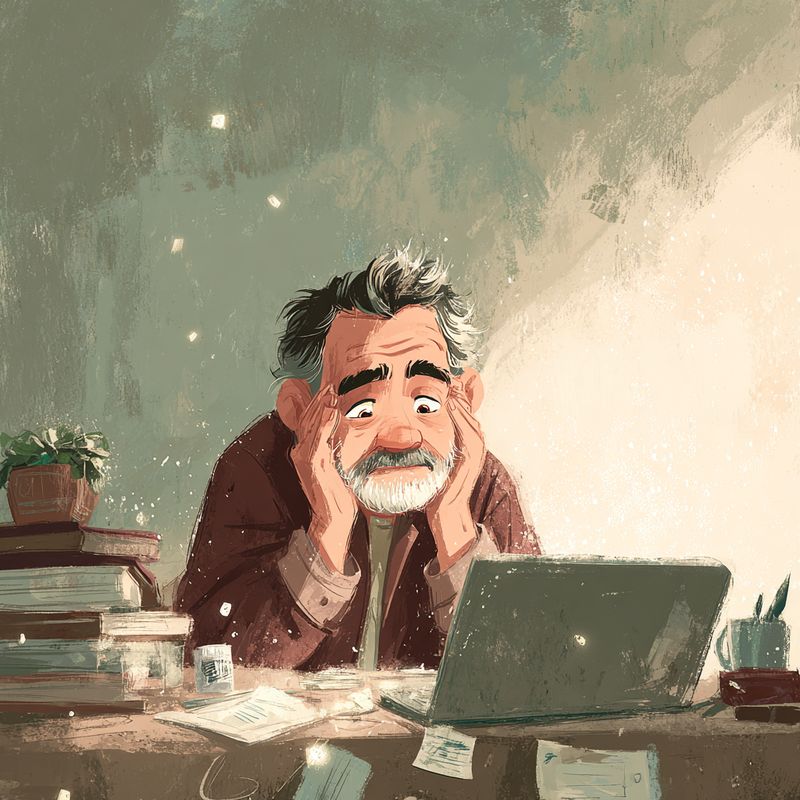
Unstable income doesn’t just stress your bank account. It stresses your brain into stopping you from working altogether.
If you’re self-employed and find yourself hesitating to start new projects, pitch new clients, or plan your finances during slow periods, you’re not lazy. Research consistently shows that income uncertainty triggers the same threat-response systems that evolution built to protect you from physical danger. The result is a paralysis that feels like procrastination but runs much deeper. According to a 2007 meta-analysis published in Psychological Bulletin by Piers Steel, 20-25% of adults identify as chronic procrastinators, with rates measurably higher among people in uncertain work situations. For freelancers trapped in the feast or famine cycle, that number almost certainly skews higher still.
The good news: this is solvable. Not by waiting for financial security to arrive, but by understanding what’s actually happening in your head.
Why Does Income Uncertainty Make It So Hard to Start?
The brain reads financial unpredictability as a threat, not an inconvenience. When you don’t know whether this month’s work will pay next month’s rent, your nervous system activates avoidance responses that feel protective but actively prevent you from doing the thing that might fix the problem.
In The Happy Brain (2018), neuroscientist Dean Burnett explains that the brain’s threat-detection system becomes overactive when facing uncertain outcomes, triggering avoidance behaviors that feel protective in the moment. The cruel irony for the feast or famine freelancer is that the avoidance behavior (not pitching, not starting, not planning) makes the famine phase worse and the anxiety stronger.
This isn’t a character flaw. It’s a mismatch between an ancient survival system and a modern economic reality.
Research published in Advances in Motivation Science by Pychyl and Sirois (2016) found that people are 40% more likely to procrastinate when facing tasks with ambiguous deadlines or uncertain payoffs. For a self-employed professional, almost every task carries both. A pitch might not land. A project might not renew. An invoice might not get paid on time. Every task is ambiguous by default.
Is This Really an Emotion Problem, Not a Time Management Problem?
Yes. And this reframe matters enormously, because it changes what solutions actually work.
Organizational psychologist Adam Grant, drawing on Wharton research into procrastination and emotion regulation, has argued that procrastination is fundamentally an emotion regulation problem, not a productivity problem. People procrastinate when they’re anxious or uncertain about a task, not when they lack the right scheduling system.
Grant also notes, referencing research connected to his book Think Again (2021), that chronic procrastination rooted in anxiety about uncertain outcomes tends to be destructive, while strategic delays based on genuine reflection can sometimes improve output. The distinction matters: if you’re waiting because you’re genuinely gathering information, that’s different from waiting because the uncertainty feels unbearable.
For freelancers dealing with uncertain work schedule procrastination, the standard productivity advice (just start, set a timer, break it into small tasks) often fails because it treats a threat response like a scheduling problem. Your brain isn’t confused about when to work. It’s scared.
Judson Brewer, a psychiatrist at Brown University and author of The Craving Mind (2017), puts it plainly: procrastination is actually a way we regulate emotions in the short term. When faced with uncertainty or discomfort, we avoid the task to feel better immediately. The relief is real. It’s also temporary and self-defeating.
What Does the Feast or Famine Cycle Do to Your Psychology?
The feast or famine pattern creates a specific and brutal psychological trap that most generic productivity advice completely ignores.
During feast periods, the pressure to deliver leaves little mental space for planning or building future pipelines. During famine periods, anxiety about income makes even basic tasks feel psychologically costly. The Upwork Freelance Forward Report (2020) found that 58% of freelancers report income instability as a major source of stress affecting their ability to start new projects. Not just their finances. Their ability to start.
This is the self employed job security paradox in action. The less secure your income feels, the harder it becomes to do the work that would create more security.
The famine phase also distorts your perception of effort and reward. When your nervous system is in threat mode, the brain’s reward processing shifts. Tasks that would normally feel manageable start to feel costly, uncertain, or pointless. Why pitch that client if they might say no? Why start that project if the contract might not renew? The anxious brain finds reasons to wait.
Waiting, of course, makes everything worse.
How Can Mindfulness Help You Separate Discomfort from Action?
Mindfulness doesn’t fix unstable income. But it can break the automatic link between financial anxiety and task avoidance, which is often the first thing that needs addressing.
Brewer’s research at Brown University on mindfulness-based interventions found that they can help break the procrastination cycle by increasing awareness of the urge to avoid, without judgment. The key word is awareness. You’re not trying to eliminate the discomfort of uncertainty. You’re learning to notice it, name it, and act anyway.
In practice, this looks like a brief pause before a task where you acknowledge what you’re feeling: “I’m anxious about whether this pitch will lead to work. That anxiety is real. And I can still write the email.” The feeling and the action become decoupled. This is not toxic positivity. It’s accurate labeling, and research in affective neuroscience consistently shows that naming an emotional state reduces its intensity.
For freelancers with uncertain work schedule procrastination patterns, this technique works best when paired with very small starting actions. Not “write the full proposal” but “open the document.” Not “plan my finances” but “look at last month’s numbers for five minutes.” The goal is to reduce the psychological cost of starting low enough that the threat response doesn’t fully activate.
What Practical Financial Strategies Actually Reduce the Anxiety Load?
Psychological tools are necessary but not sufficient. Structural income instability requires structural responses, and pretending otherwise is its own form of avoidance.
The most effective strategy for reducing the cognitive load of feast or famine cycles is building a cash buffer before you need it. Financial planners working with self-employed clients typically recommend holding three to six months of essential expenses in a separate account treated as off-limits except in genuine emergencies. The psychological effect of this buffer extends far beyond the financial one: research in behavioral economics consistently shows that perceived financial safety reduces anxiety-driven decision-making even when the underlying income remains variable.
Retainer arrangements are another structural tool that directly targets the unpredictability problem. Monthly retainers convert uncertain project income into something closer to a predictable baseline, reducing the frequency of the famine trough even if the feast peaks disappear too. Some freelancers resist retainers because they feel limiting. That resistance is worth examining. Security that feels boring is still security.
Diversifying income streams, even modestly, also reduces the threat response associated with any single client or project. When one client represents 80% of your income, losing them isn’t just a financial event. It activates a full threat response that can paralyze you for weeks. Spreading that concentration changes the psychological stakes of individual outcomes.
Grant’s research also supports the value of building planning rituals around financial review, rather than avoiding income data during uncertain periods. Looking at the numbers regularly, even uncomfortable ones, keeps the threat response proportionate. Avoidance tends to make the imagined threat larger than reality.
How Do You Build a Starting Practice That Survives Income Anxiety?
The goal isn’t to stop feeling anxious about uncertain income. The goal is to build a practice of starting that doesn’t depend on the anxiety being gone first.
For freelancers dealing with unstable income procrastination, consistent small starts tend to outperform sporadic large efforts. This isn’t because small tasks are inherently more productive. It’s because they maintain the neural pathway between intention and action even during high-anxiety periods. When famine hits, that pathway is still open.
Time tracking tools (including apps built specifically around accountability and task initiation) help by making the cost of not starting visible rather than abstract. Anxiety thrives in abstraction. Concrete records of what you actually did today are harder to rationalize around.
The contrarian take worth saying plainly: waiting for financial stability before building good work habits is exactly backwards. The habits are what create the stability. You can’t afford to wait.
FAQ
Is unstable income procrastination different from regular procrastination?
Yes, in important ways. Standard procrastination research focuses on task aversion, perfectionism, or poor time estimation. Unstable income procrastination adds a genuine structural stressor: the reward for completing work is uncertain, not just delayed. This activates threat-response systems more intensely and requires both emotional regulation strategies and practical financial planning to address effectively.
Why do I procrastinate most during slow periods when I have the most time?
This is one of the cruelest features of the feast or famine cycle. Slow periods reduce income certainty, which raises anxiety, which activates avoidance behavior. You have more time but less psychological capacity to use it. Research by Judson Brewer in The Craving Mind (2017) explains this as short-term emotion regulation: avoiding work tasks during anxious periods provides temporary relief, even though it makes the underlying problem worse.
Do mindfulness techniques actually work for freelancers or is that just wellness advice?
The evidence is specific enough to take seriously. Brown University research led by Judson Brewer found that mindfulness-based interventions measurably reduced procrastination by helping people notice avoidance urges without automatically acting on them. The technique doesn’t require meditation retreats. Even brief daily practice of naming emotional states before starting work tasks shows measurable effects on task initiation rates.
How much of a cash buffer do I need before the anxiety actually reduces?
Research in behavioral economics suggests the threshold effect kicks in around one to two months of essential expenses for most people, with three months providing significantly more relief. Crucially, the buffer needs to be in a separate account you don’t monitor daily. Mixing it with operating funds reduces its psychological effect even if the total number is the same.
Can the Time Is Luck app help with feast or famine procrastination specifically?
Apps that create consistent starting rituals and make task initiation visible are particularly useful for freelancers because they maintain work momentum during low-income periods when motivation naturally drops. The key feature to look for is anything that reduces the activation cost of beginning, whether that’s simple task logging, time tracking, or short structured sessions. The goal isn’t to replace financial planning but to keep the work habit alive while you do it.