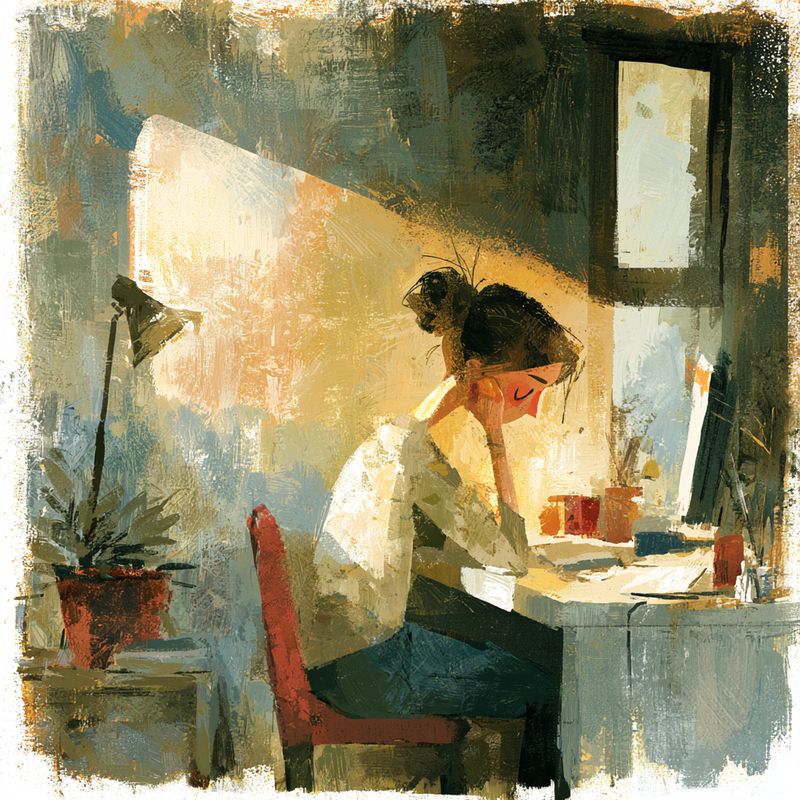
Most journalists believe deadline pressure sharpens their thinking. The science says the opposite is true, and the gap between those two beliefs is where careers quietly fall apart.
Deadline pressure kills creativity not by removing motivation, but by triggering a neurological state that is chemically incompatible with original thinking. The adrenaline hit you feel when the clock ticks down isn’t creative activation. It’s survival mode. And survival mode, by design, narrows everything. Research published across multiple cognitive psychology studies between 2008 and 2015 found that creative problem-solving performance decreases by approximately 30 to 40% under conditions of high time pressure compared to self-paced conditions. That’s not a marginal drop. That’s the difference between work you’re proud of and work you’re embarrassed by.
Understanding why this happens, neurologically, is the first step to protecting yourself from it.
Why does deadline pressure kill creativity instead of focusing it?
The popular myth is that pressure produces focus. For repetitive tasks with known solutions, that’s broadly true. For creative work, where the whole point is to find a connection that doesn’t yet exist, pressure does the opposite of focusing you. It locks you into a tunnel.
In their 2015 book The Eureka Factor, neuroscientists John Kounios and Mark Beeman explain that insight moments, the genuine “aha” breakthroughs that produce original journalism, occur when the brain shifts from focused analytical thinking to a broader associative state. Time pressure and stress actively hinder that shift. Their neuroimaging research, published in the Proceedings of the National Academy of Sciences, goes further: the brain’s insight network requires a relaxed, diffuse attention state that is simply incompatible with the narrow focus demanded by deadline pressure.
A 2009 neuroimaging study by Kounios and Beeman found that individuals under high time pressure show decreased activation in the anterior superior temporal gyrus, the brain region most directly associated with creative insight. Less activation there means fewer connections made. Fewer connections means thinner, more predictable work.
This is why time pressure creative block feels so disorienting. You’re not lazy. You’re not uninspired. Your brain has physically shifted into a mode that makes original thinking harder to access.
What’s actually happening in your brain when the clock is running?
When you perceive a deadline as a threat (and most journalists do perceive it that way, even when they don’t consciously register it), the amygdala triggers a stress response. Cortisol rises. Adrenaline spikes. Your prefrontal cortex, the part responsible for flexible, divergent thinking, takes a back seat.
Astronaut Chris Hadfield, whose work on performance under extreme conditions has been widely cited in psychology circles, describes this clearly in his 2013 book An Astronaut’s Guide to Life on Earth. Under extreme pressure, he writes, the brain narrows its focus to survival mode, which eliminates the cognitive flexibility required for creative problem-solving. Hadfield adds, from his performance psychology talks, that pressure doesn’t create focus for creativity. It creates tunnel vision that eliminates innovative thinking.
Hadfield was talking about spacewalks. But the neurological mechanism is identical for a journalist staring at a blank document with 45 minutes left.
The cruel irony is that the harder you push under that state, the worse it gets. Rushing makes work worse not because you care less, but because effort and creativity don’t share the same neural pathway. You can brute-force a word count. You can’t brute-force an original angle.
Approximately 88% of professionals report that deadline pressure negatively impacts the quality of their creative work, according to the Adobe Creative Confidence report from 2012. Most of those professionals also report continuing to work under exactly those conditions anyway, because they don’t have a framework for doing anything different.
Is there a point where pressure becomes genuinely toxic to professional quality?
Yes. And most journalists cross that point far more often than they realise.
Steven Pressfield, in his 2002 book The War of Art, describes what he calls Resistance: the internal force that blocks creative output. His counterintuitive finding is that panic and artificial urgency don’t overcome Resistance. They intensify it. In Turning Pro (2012), Pressfield frames it this way: when professionals panic under deadline pressure, they invoke the amateur’s mindset, which actually strengthens creative paralysis rather than breaking through it.
This matters because journalism culture treats deadline panic as a rite of passage. The reporter who pulls an all-nighter, who “performs under pressure,” who files at the last second: these are celebrated archetypes. But what that culture actually normalises is the regular production of work that’s 30 to 40% less creative than the same person could produce with even modest structural protection around their thinking time.
Rushing makes work worse. Not always in ways that are immediately visible. Sometimes the piece files fine, and the editor is happy, and the writer never knows what the piece could have been with a different approach to the clock.
4 ways to protect your creative thinking before the deadline takes over
The goal isn’t to eliminate deadlines. That’s not a realistic ask in any newsroom. The goal is to create protected conditions for the diffuse, associative thinking that creative work actually requires, before the pressure window closes.
1. Front-load your creative work to the low-pressure window
The most effective structural shift is timing. Do your conceptual work, angle development, and structural decisions early in the available time, when pressure is lowest. Save the mechanical work (writing, editing, fact-checking) for the high-pressure window closer to the deadline.
This works because it matches the cognitive demands of each task to the brain state available at each time. Analytical tasks tolerate stress reasonably well. Creative tasks don’t.
2. Use deliberate diffuse thinking before you try to solve a creative problem
Kounios and Beeman’s research on insight specifically identifies what triggers the associative brain state: low-stakes mind-wandering, physical movement, reduced visual stimulation. A short walk before you try to crack an angle isn’t procrastination. It’s the neurological precondition for the insight you’re chasing.
This runs directly against the instinct to sit down and grind. But the evidence is consistent: the insight comes after the diffuse state, not during forced effort.
3. Separate the generative phase from the evaluative phase with a hard boundary
One of the fastest ways deadline pressure kills creativity is by collapsing two cognitively distinct activities into one. Generating ideas and evaluating ideas use different brain states. Doing them simultaneously under pressure produces the worst of both: watered-down ideas that are already half-edited before they’re fully formed.
Set a timer for pure generation. No editing, no self-censorship, no filtering. Then, separately, evaluate what you have. Even ten minutes of true generative space, protected from self-criticism, can produce angles you wouldn’t reach through anxious, pressured output.
4. Reframe the deadline as a constraint on execution, not on thinking
Most journalists unconsciously treat the deadline as a constraint on everything, including the quality and originality of the thinking that produces the work. That framing is self-defeating.
A more functional reframe: the deadline governs when words leave your hands. It doesn’t govern when your best ideas arrive. Protecting a 20-minute window of low-pressure conceptual thinking at the start of any creative task isn’t a luxury. It’s the thing that determines whether you’re filing your best work or your most pressured work.
Time Is Luck isn’t about fighting the clock. It’s about understanding when to use which part of your brain, so the clock stops destroying your best thinking before it reaches the page.
FAQ
Does deadline pressure ever help creativity?
For simple, well-defined tasks with known solutions, mild time pressure can improve focus and reduce overthinking. But for genuinely creative work, where the task involves finding novel connections or original angles, the neurological evidence is consistent: pressure narrows cognitive flexibility and reduces access to the associative brain states where insight actually occurs. The feeling of creative momentum under deadline is usually adrenaline, not creative activation.
Why do some journalists feel like they do their best work under pressure?
This is one of the most persistent confusions in creative professional culture. Adrenaline feels like sharpness. The urgency of a ticking clock produces a sensation of focus that can be mistaken for creative flow. But as Kounios and Beeman’s neuroimaging research shows, the brain regions most active under pressure are not the regions associated with creative insight. The work produced may feel urgent and alive in the moment. It’s often measurably less original than what the same writer produces under low-pressure conditions.
How much does deadline pressure actually reduce creative output?
Studies on creativity and temporal constraints in cognitive psychology literature, spanning 2008 to 2015, consistently find that creative problem-solving performance decreases by approximately 30 to 40% under high time pressure compared to self-paced conditions. That’s a substantial reduction in quality that compounds over a career spent working predominantly in high-pressure windows.
What’s the fastest way to shift out of pressure-induced creative block?
Physical movement is the most evidence-supported rapid intervention. Walking, in particular, has been shown to increase divergent thinking by promoting the diffuse attentional state that the brain’s insight network requires. Even a five-minute walk away from the screen before returning to a creative problem can meaningfully improve access to original thinking. The key is treating it as a cognitive tool, not as avoidance.
Can journalists train themselves to be more resilient to deadline pressure over time?
Partially. Familiarity with a domain reduces the cognitive load of execution, which frees up some capacity for creative thinking even under pressure. But the neurological constraint described by Kounios, Beeman, and Hadfield isn’t primarily a skills gap. It’s a structural feature of how the stressed brain allocates resources. The more durable solution is structural: building protected creative time into the workflow before pressure escalates, rather than trying to perform creative work inside the pressure window.