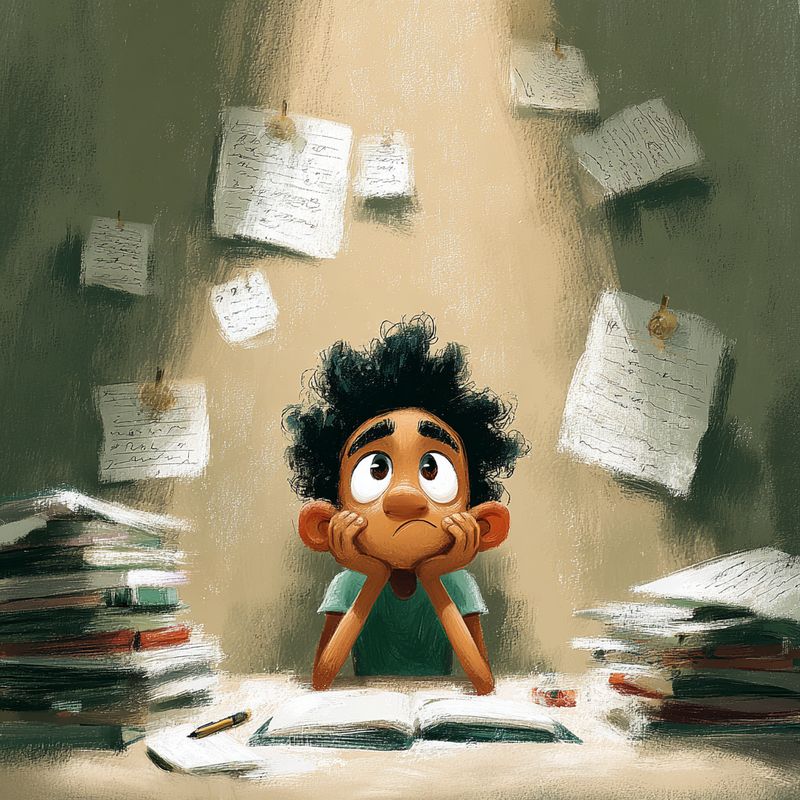
The structure you keep avoiding is probably the thing standing between you and your best work.
Here’s the short version: the structure kills creativity myth has it completely backwards. Research in neuroscience and organizational psychology consistently shows that constraints, routines, and systems don’t suppress creative thinking. They create the cognitive conditions required for it. When your brain isn’t burning energy managing logistics and anxiety, it can actually do the thing you hired it to do: generate ideas.
Why Do We Believe Structure Kills Creativity?
The romanticized image of the tortured genius, striking at 3am in a chaos of empty coffee cups, is a cultural story. It’s not a productivity model.
The spontaneous inspiration myth persists partly because we remember the moments of breakthrough, not the weeks of structured preparation that preceded them. We credit the lightning bolt and forget the rod.
Psychologist Teresa Amabile’s longitudinal research on creative professionals, published in The Progress Principle (2011, co-authored with Steven Kramer), found something that cuts against this romantic narrative directly. According to Amabile’s research, people are more creative when they have clearly defined goals and the resources they need, combined with freedom in how they achieve those goals. Structure and autonomy aren’t opposites. They’re partners.
Amabile’s Harvard Business School research also identifies what actually kills creativity: the perception of time pressure without autonomy, and constant monitoring without trust. Notice what’s absent from that list. Routine. Systems. Discipline.
What Happens in Your Brain When You Work Without Systems?
When you operate without creative systems, your prefrontal cortex carries a hidden tax. It’s not just managing the creative task. It’s also tracking every open loop: the deadline you haven’t scheduled, the reference file you can’t find, the nagging sense that you’ve forgotten something important.
Productivity researcher David Allen describes this drain precisely in Getting Things Done: The Art of Stress-Free Productivity (2015):
“Your mind is for having ideas, not holding them. The reason most people’s creative thinking is so clogged up is because they’re trying to hold all their stuff in their head.”
That cognitive clog is measurable. Research supporting Allen’s GTD methodology found that people who use structured organizational systems report 30% more creative output compared to those working without systematic organization (David Allen Company research, 2001-2015). The mechanism isn’t mysterious. When your system holds the information, your brain stops white-knuckling it.
Allen makes an adjacent point that deserves its own line: “The effectiveness of your work will be directly proportional to your ability to relax.” For most creative professionals, that reads as counterintuitive. But it’s neurologically accurate.
Neuroscientists John Kounios and Mark Beeman, writing in The Eureka Factor (2015), found that the brain is most creative when it isn’t directly focused on the problem. Insight moments occur when the mind enters a more diffuse, wandering state. Their research, also published in the Proceedings of the National Academy of Sciences (2008), showed that creative breakthroughs are significantly more likely to occur after periods of structured work followed by deliberate breaks. The structure isn’t the enemy of the insight. It’s the precondition.
How Does Routine for Artists Actually Work in Practice?
Look at the working habits of almost any prolific creative professional and you’ll find something unglamorous: a consistent routine for artists that borders on the obsessive.
Maya Angelou wrote in hotel rooms she rented specifically for work, arriving at 6:30am every morning. Haruki Murakami runs ten kilometers a day and is in bed by 9pm. Neither approach sounds like bohemian freedom. Both produced extraordinary bodies of work.
This isn’t coincidence. Routine reduces the number of decisions your brain has to make before the creative work begins. Every decision costs something. When you’ve already decided when you work, where you work, and what you’re working on, you arrive at the creative task with a full tank rather than a depleted one.
Steven Pressfield, in The War of Art (2002), frames the avoidance of discipline as a specific psychological force he calls Resistance. According to Pressfield, Resistance feeds on fear, ignorance, guilt, self-doubt, and the fear of both failure and success. The more you confront and overcome that resistance, the more you actualize your creativity. His later book Turning Pro (2012) extends this further:
“The professional knows that Resistance is like a dragon guarding a portal. If you go down in defeat, all you have to do is get back up on the horse and ride back through that gate.”
The word “professional” is doing a lot of work there. Pressfield’s argument is that treating creative work as a profession, with the discipline that implies, is what separates people who make things from people who intend to.
What Does the Research Say About Structure vs Spontaneity?
The structure vs spontaneity debate tends to be framed as a binary, but the research doesn’t support that framing.
Amabile’s longitudinal studies on creative professionals found that artists and writers who maintain consistent daily routines report both higher quality output and greater overall satisfaction with their work (Teresa Amabile, The Progress Principle, 2011). This isn’t about grinding harder. It’s about creating reliable conditions for good work to happen.
The neurological picture reinforces this. The brain has two broad attentional modes: focused, deliberate processing and diffuse, associative processing. Both are necessary for creative work. Focused work builds the raw material. Diffuse states, the walks, the showers, the deliberate pauses, connect it into something new. Structure creates both. It protects the focused blocks and, crucially, it schedules the breaks that allow insight to surface.
Without structure, most people default to a third mode: anxious non-work. The scrolling, the half-starts, the vague guilt. That state is neither focused nor genuinely diffuse. It’s cognitively expensive and creatively barren.
How Do You Build Creative Systems Without Strangling Spontaneity?
The goal isn’t a rigid system that dictates every minute. The goal is a creative discipline architecture that handles the predictable so the unpredictable has room to breathe.
Practically, this breaks down into three categories:
Capture systems. Every idea, task, and commitment gets out of your head and into a trusted external system immediately. This is Allen’s core argument. The brain’s job is generating ideas, not storing them.
Time boundaries. Fixed start and end times for creative work matter more than their length. A two-hour block you actually protect is worth more than a vague intention to work all day. Amabile’s research specifically identifies time pressure without autonomy as a creativity killer, but the solution isn’t removing time pressure entirely. It’s designing time boundaries you control.
Transition rituals. Brief, repeatable actions that signal to your brain that creative mode is beginning. These don’t need to be elaborate. The same playlist, the same physical space, the same warm-up exercise. Over time, these rituals function as cognitive shortcuts that reduce the ramp-up cost of deep work.
None of these constrain what you create. They constrain when and how you show up to create. That distinction matters enormously.
Here’s the contrarian take worth sitting with: most creative blocks aren’t about lacking inspiration. They’re about lacking structure. The blank page isn’t the problem. The absence of a system that gets you reliably to the blank page is.
FAQ
Does having too much structure actually limit creative thinking?
Research suggests the concern is usually misplaced. Teresa Amabile’s work on creative professionals found that structure around process (when, where, and how you work) doesn’t limit creative output. What limits output is structure that dictates outcomes, specifically being told what to create rather than being given clear goals and autonomy over the path. The former enables creativity; the latter suppresses it.
How long does it take for a creative routine to start producing results?
Neuroscience research on habit formation suggests most behavioral routines begin producing reliable cognitive benefits within four to eight weeks of consistent practice. For creative routines specifically, the benefit comes from reduced decision fatigue and smoother access to focused states, both of which accumulate as the routine becomes automatic. Consistency matters more than perfection.
What’s the difference between a creative system and just being rigid?
A creative system handles logistics and reduces cognitive load. Rigidity prescribes outcomes and eliminates adaptability. The distinction is whether your system serves the work or controls it. A good system tells you when to show up and where to capture ideas. It doesn’t tell you what those ideas have to be.
Can deadlines actually help creativity rather than harm it?
Yes, with an important condition. Amabile’s Harvard research found that time pressure harms creativity when it’s imposed externally without autonomy. But self-imposed or agreed deadlines with clear scope can help by forcing prioritization and preventing the perfectionism loop that keeps work from ever being finished. The key variable is whether you have agency over how you meet the deadline.
What should a creative person do if they genuinely hate routine?
The resistance to routine is often worth examining before abandoning it. Steven Pressfield’s framework in The War of Art suggests that resistance to the very practices that would help is a predictable psychological pattern, not a reliable signal about what works. That said, systems don’t need to feel rigid to function. Even a loose anchor (same approximate start time, same first task) provides enough structure to reduce cognitive drag without feeling like a schedule.