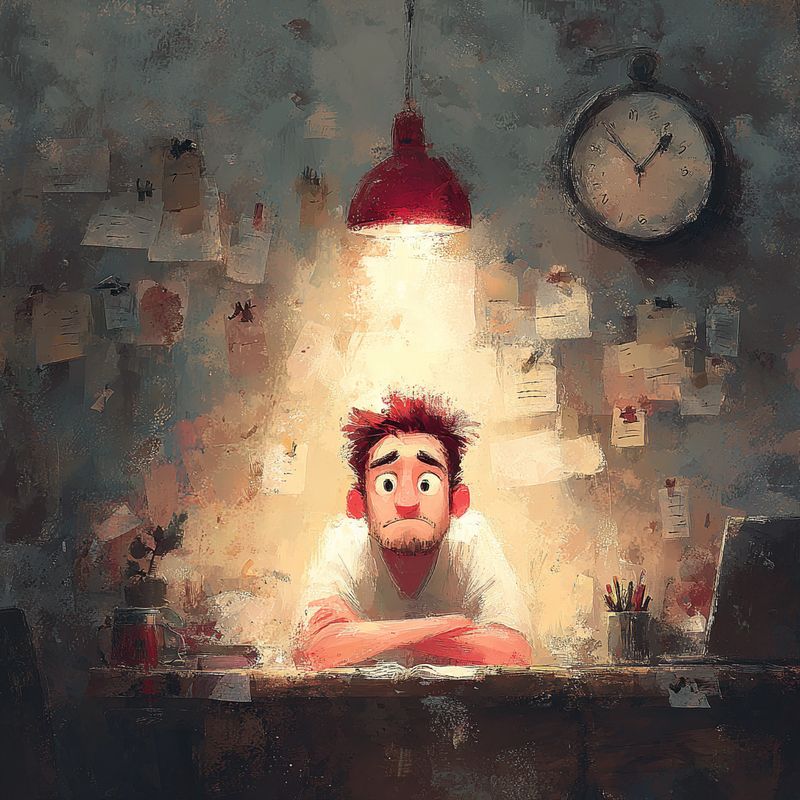
Success can quietly become the most paralyzing thing that ever happens to you.
If you’ve had a piece of work go viral, win an award, or simply outperform everything you’ve made before, you already know the strange weight that follows. The pressure from past wins doesn’t arrive as celebration. It arrives as silence. A blank canvas that feels less like possibility and more like a trap.
This isn’t weakness, and it isn’t ingratitude. It’s neuroscience. Research consistently shows that creative professionals face a paradox: the bigger the win, the harder the next start becomes. Understanding why that happens is the first step toward doing something about it.
Why does success make it harder to create again?
The brain doesn’t separate “exciting creative risk” from “potential threat.” After a significant win, your threat-detection system recalibrates. The next project stops feeling like exploration and starts feeling like a high-stakes repeat performance. Every blank page carries the implicit question: will this be as good as the last one?
This is what researchers call the Success Paradox. The neural pathways that helped you achieve something significant now treat repetition of that success as the baseline expectation, not the exception. Psychologist Heidi Grant, writing in her HBR columns and NeuroLeadership Institute research, describes how focusing too much on past successes can create what researchers call “goal complacency,” a false sense that you’ve already achieved what you need to achieve. The result isn’t motivation. It’s stasis.
The fear of making something worse than your best work becomes its own creative block after viral work. You start auditing ideas before you’ve even tried them. The internal critic, which was once a useful quality filter, becomes a gatekeeper that won’t let anything through.
What is impostor syndrome after success, and why does it get worse?
Most people associate impostor syndrome with feeling underqualified. But research suggests it intensifies after success, not before it.
A foundational study by Clance and Imes, published in Psychotherapy: Theory, Research and Practice in 1978, found that approximately 40% of high-achieving individuals report experiencing impostor syndrome after major success. The logic feels counterintuitive until you understand what the brain is doing: the bigger the success, the more exposure you now have, and the more you believe a failure will cost you.
Impostor syndrome after success works differently from the pre-success version. Before a win, you worry you’re not good enough to get there. After a win, you worry that the success was a fluke, that people now expect something you can’t reliably produce, and that the next piece of work will expose the truth.
Creative perfectionism steps in as the defence. If you can just make something flawless enough, the logic goes, you’ll prove the first success wasn’t a mistake. In her 2010 book The Gifts of Imperfection, researcher Brené Brown writes directly to this dynamic:
“Perfectionism is not the same thing as striving to be your best. Perfectionism is the belief that if we live perfect, look perfect, and act perfect, we can minimize or dodge the pain of blame, judgment, and shame.”
Perfectionism, in other words, isn’t a standard. It’s a shield. And shields are heavy to carry while you’re trying to make something.
Recent research on creative burnout supports this: studies from the 2015 to 2020 period on perfectionism and performance suggest that around 30% of creative professionals struggle with creative blocks following viral or highly successful work. That’s not a small minority. That’s roughly one in three people who’ve had a breakthrough, now stuck behind it.
How does the brain turn your best work into a threat?
Here’s the mechanism most people don’t realise is happening.
When something you made performs exceptionally well, your brain stores that outcome as the new reference point. Neuroscientists call this “prediction error” processing. Your brain updates its model of what “normal” looks like based on what just happened. So your viral post, your chart-topping track, your award-winning design, these become the new floor, not a ceiling.
Every subsequent project now gets evaluated against that floor before it even exists. You’re not comparing a finished piece to another finished piece. You’re comparing a half-formed idea to a fully realised success. That’s a competition the idea will lose every single time.
Astronaut Chris Hadfield, in his 2013 book An Astronaut’s Guide to Life on Earth, argues that deciding in advance to do things perfectly is a recipe for disappointment and inaction. His observation from years of high-stakes training is that what you actually need to practise is being comfortable with failure, treating each attempt as data rather than verdict.
The same framework applies here. Your brain has been trained, by success, to treat the next creative attempt as a verdict. Retraining it means deliberately lowering the stakes of output, not the quality of attention.
What does recovery from creative paralysis actually look like?
This is where most advice goes wrong. It tells you to “just start” or “lower your expectations,” which sounds reasonable but misses the point. The block isn’t laziness. It’s an active fear response. You can’t willpower your way out of a fear response.
The recovery strategies that research supports are built around reframing success as iterative rather than destinational. Think of it less like a destination you’ve reached and more like a training protocol where each repetition builds capacity, regardless of individual performance.
Heidi Grant, in her 2012 book 9 Things Successful People Do Differently, notes that one of the most common reasons goals fail is that people treat them as all-or-nothing scenarios: either you succeed completely, or you’ve failed. Breaking this binary is the core cognitive task for anyone experiencing a creative block after viral work.
Here’s what that looks like practically:
Separate creation from evaluation. Give yourself defined periods where the only job is to make something, with zero assessment during that window. The evaluator brain and the creator brain use different cognitive modes. Running them simultaneously is what produces paralysis.
**Use “low-stakes containers.” ** Sketchbooks, voice memos, private playlists, rough drafts that nobody will see. The goal isn’t to hide your work permanently. It’s to create a space where the pressure from past wins doesn’t have permission to enter.
Redefine the success metric for the next project. Not “will this be as good as my last thing” but “will I learn something from making this.” Brené Brown, in her 2018 book Dare to Lead, is unambiguous: “Perfectionism is self-abuse of the highest order.” Reframing your metric from output quality to process engagement is the structural change that makes the next step possible.
Create publicly and imperfectly, deliberately. Share rough work. Post the experiment. Publish the thing you’re not sure about. This isn’t recklessness; it’s recalibration. It teaches your nervous system that imperfect output doesn’t end your creative identity.
How do you rebuild creative momentum without repeating the past?
The goal isn’t to recreate your viral success. That framing is the trap. The goal is to remember that the work that went viral was almost certainly not made under the same pressure you’re now trying to create under.
Most creative breakthroughs happen when the stakes feel low. When you were experimenting, playing, making something for the process rather than the outcome. The work that connected with people usually came from a place of genuine curiosity, not strategic calculation.
Chris Hadfield’s insight from astronaut training applies directly: the pressure to maintain a successful image can paralyse you from taking the risks necessary for real growth and innovation. He trained for years for missions that might never happen, and found that the training itself, not the mission, was where competence actually developed.
For creative professionals, this means treating every new project as training, not performance. The musician making a track nobody will hear. The writer filling a journal nobody will read. The designer sketching something with no brief. These aren’t failures to ship. They’re the reps that make shipping possible again.
Brené Brown’s research on vulnerability points to something most perfectionism advice ignores: the belief that you need to perform perfectly in order to be worthy of connection is more dangerous than making a mistake, as she argues across her work in Dare to Lead and the Unlocking Us podcast. Creative vulnerability, making something uncertain in public, is how you dissolve the fear that success accidentally built.
The block is real. The fear is real. But neither of them is permanent, and neither of them is who you are.
FAQ
Is it normal to feel worse after creative success than before it?
Yes, and research backs this up. A 1978 study by Clance and Imes in Psychotherapy: Theory, Research and Practice found that around 40% of high-achieving individuals experience impostor syndrome after major success. The post-success period often feels harder because the stakes feel higher, and your brain has recalibrated what “normal” looks like based on your best performance.
What’s the difference between creative perfectionism and high standards?
High standards focus on the quality of the work itself. Creative perfectionism focuses on the avoidance of shame, judgment, or failure. Brené Brown distinguishes the two clearly in The Gifts of Imperfection: striving to do your best is healthy, but perfectionism is a defensive response to the fear of being seen as inadequate. One drives creation. The other blocks it.
How long does creative block after viral success typically last?
There’s no universal timeline, and the research doesn’t support a single answer. What the evidence does suggest is that the block tends to persist for as long as the creator treats every new project as a verdict on whether their success was deserved. Reframing from outcome-based to process-based thinking tends to shorten the period significantly.
Can time away from creating help, or does it make the pressure worse?
Short, intentional breaks can help reset the threat response. Prolonged avoidance typically makes it worse. The longer you stay away from creating, the more the next attempt feels like a major event. Low-stakes, private creative practice during a break (journaling, sketching, voice memos) tends to keep the creative muscle active without triggering the performance anxiety.
Why do musicians, writers, and designers seem especially vulnerable to this?
Creative professionals work in fields where output is public, personal, and comparative. A single piece of work carries identity weight in a way that most professional outputs don’t. When that work succeeds publicly, the next attempt isn’t just a project; it’s a test of whether the first success was real. That’s a uniquely heavy cognitive load, and it’s why roughly 30% of creative professionals report significant blocks following highly successful work, according to research on perfectionism and creative burnout from the 2015 to 2020 period.