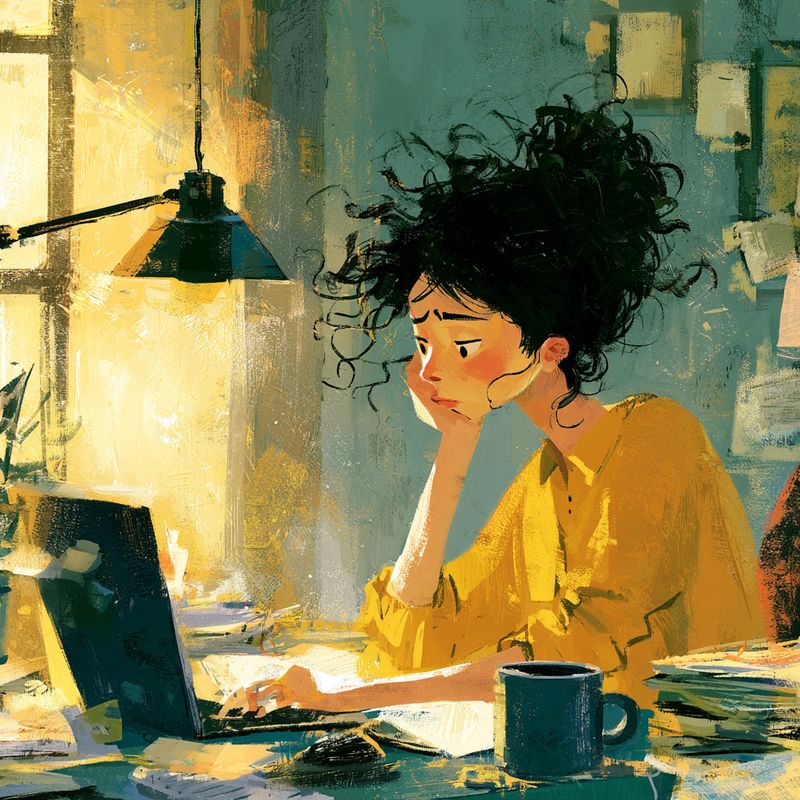
Most university students don’t procrastinate because they’re lazy or disorganised. They procrastinate because starting an assignment feels genuinely awful, and their brain is trying to protect them from that feeling. Research shows that procrastination affects between 46% and 95% of university students, depending on the population studied (Steel, 2007, Psychological Bulletin). That’s an enormous range, and it tells you something important: this isn’t a niche problem, and it isn’t a character flaw. The procrastination cycle is a near-universal student experience, and breaking the last-minute assignment habit requires understanding what’s actually driving it.
Why is procrastination really an emotion problem, not a time problem?
The standard advice about procrastination focuses on schedules, productivity systems, and time-blocking apps. That advice misses the point almost entirely. The reason students fall into the habit of waiting isn’t that they don’t know how to plan; it’s that they’re trying to avoid a feeling.
Organisational psychologist Adam Grant, drawing on Wharton research into procrastination and motivation, argues that procrastination is fundamentally an emotion regulation problem, not a productivity problem. According to Grant, people procrastinate when they’re trying to avoid the negative emotions associated with a task: fear of failure, boredom, self-doubt, or the discomfort of not knowing where to begin.
Neuroscientist Dean Burnett supports this framing. In his book The Idiot Brain (2016), Burnett explains that the brain isn’t well-equipped to weigh future consequences against present discomfort. The immediate unpleasantness of sitting down to write a 3,000-word essay feels far more real and urgent than the vague future pain of submitting a poor piece of work. So the brain takes the path of least resistance. It avoids.
This is why willpower-based advice (just start, set a timer, break it into steps) fails so many people. You can’t schedule your way out of an emotion regulation problem.
How does the procrastination cycle become self-reinforcing?
Here’s where things get genuinely complicated. For a significant number of students, the procrastination cycle doesn’t just persist despite deadline pressure; it actually gets sustained because of it.
Approximately 20% of adults identify as chronic procrastinators (Steel, 2007, Psychological Bulletin). But chronic procrastination isn’t simply failing to start tasks. It’s a feedback loop with a reward built into it.
The loop works like this. A student receives an assignment. The anxiety about doing it poorly, combined with the sheer size of the task, makes starting feel threatening. So they avoid it. Avoidance provides short-term relief. As the deadline approaches, the adrenaline of deadline pressure kicks in, focus sharpens, and the student produces work under pressure that turns out to be good enough, sometimes even genuinely good. They hand it in. They pass.
That outcome teaches the brain a dangerous lesson: waiting works.
Grant, in Think Again (2021), notes that some people are genuinely productive procrastinators who delay starting but use time pressure to focus and perform better. The critical question, Grant suggests, is whether waiting until the last minute actually improves the work, or whether the student is simply rationalising a habit that feels rewarding but carries increasing risk.
Research published in the European Journal of Personality by Sirois and Pychyl (2013) found that students who procrastinate tend to report higher stress levels and lower overall academic performance compared to non-procrastinators. The occasional late-night success doesn’t cancel out the cumulative cost.
What does anxiety do to your ability to focus on assignments?
The emotional dimension of chronic procrastination has a neurological layer worth understanding. When anxiety about a task rises, attention becomes harder to sustain, and distraction becomes more tempting.
Jonathan Schooler, whose research on consciousness and attention has been published in Consciousness and Cognition, has found that mind-wandering and attention failures contribute significantly to procrastination. When students struggle to maintain focus on a task, they become more likely to delay starting it and more likely to seek out distractions instead.
This creates its own reinforcing pattern. Anxiety makes focus harder. Harder focus makes avoidance more tempting. Avoidance increases anxiety as the deadline approaches. The brain, as Burnett notes in The Happy Brain (2018), treats procrastination as a symptom of anxiety or low mood rather than laziness, avoiding tasks that trigger negative emotions and locking students into a cycle that becomes harder to exit the longer it runs.
The practical implication is significant. Students who believe they’re procrastinating because they’re bad at time management are looking at the wrong problem. The question isn’t “how do I schedule better?” It’s “what emotion am I avoiding, and how can I tolerate it long enough to begin?”
How do you break the last-minute assignment habit in 4 steps?
Breaking out of the procrastination cycle doesn’t require a personality overhaul. It requires building tolerance for the discomfort that drives avoidance in the first place. These four steps address the emotional roots of the habit of waiting, not just its surface symptoms.
Step 1: Name the emotion driving the avoidance
Before you open the document, pause and ask what you’re actually feeling. Is it fear that the work won’t be good enough? Boredom at the thought of the topic? Resentment that the task was assigned at all? Naming the emotion reduces its intensity slightly and separates it from the task itself. The assignment isn’t the threat; the feeling is. And feelings pass.
Step 2: Lower the entry point until resistance disappears
The goal isn’t to write the essay. The goal is to open the document and write one sentence. Not a good sentence. Any sentence. The brain resists tasks that feel large and evaluative. Shrinking the entry point to something genuinely non-threatening disrupts the avoidance response before it fully activates. This isn’t a productivity hack; it’s an anxiety management technique disguised as a productivity hack.
Step 3: Separate drafting from evaluating
A significant portion of assignment anxiety comes from trying to produce good work and judge that work simultaneously. These are two cognitively different processes, and running them together creates a paralysing feedback loop. Set a timer for 20 minutes and write without reading back. Ugly, incomplete, structurally wrong: it doesn’t matter. Evaluation comes later. Giving yourself explicit permission to produce bad first drafts removes the emotional stakes from the initial work, which is exactly where procrastination gets its grip.
Step 4: Track the pattern, not just the outcome
Chronically late students often only pay attention to whether they submitted on time, not to how they felt during the process. Keeping a brief log of when anxiety peaked, when avoidance was hardest, and what finally made starting possible gives you real data about your personal procrastination cycle. Over time, that data reveals which conditions make the habit of waiting more likely, so you can adjust those conditions rather than just criticising yourself after the fact.
Using a tool like Time Is Luck can help with this: tracking patterns over multiple assignments builds a clearer picture of when and why the cycle kicks in, turning vague self-criticism into something actionable.
Does fixing procrastination actually improve academic performance?
The short answer is yes, and the data is reasonably clear. Sirois and Pychyl’s 2013 research in the European Journal of Personality links chronic procrastination with higher stress and lower academic outcomes across student populations. Steel’s 2007 meta-analysis in Psychological Bulletin, which remains one of the most comprehensive reviews of procrastination research ever published, confirms that self-regulatory failure (the inability to start and sustain tasks despite intending to) is consistently associated with worse performance.
But there’s a subtler point here worth making directly. The goal isn’t to eliminate the feeling of pressure entirely. Some deadline pressure is useful, and Grant’s work on productive procrastination acknowledges that. The goal is to stop being controlled by it. A student who consciously chooses to work intensively in the final days before a deadline, having already laid groundwork and processed the emotional resistance earlier, is in a fundamentally different position to a student who avoids the task entirely and scrambles at the last minute out of panic.
One is a strategy. The other is a trap.
FAQ
Is procrastination a sign of laziness?
No. Research consistently frames procrastination as an emotion regulation problem rather than a character flaw. As neuroscientist Dean Burnett explains in The Idiot Brain (2016), the brain avoids tasks that trigger negative emotions. That’s a neurological pattern, not a moral failing.
Why do some students work better under pressure?
Adam Grant’s research on productive procrastination, discussed in Think Again (2021), suggests that deadline pressure genuinely helps some people focus. The risk is that students interpret occasional last-minute success as proof that the habit of waiting is necessary, when in reality it may just be tolerable. The cumulative stress and performance costs documented in research suggest it’s rarely the optimal approach.
How common is chronic procrastination among university students?
Very common. Steel’s 2007 meta-analysis in Psychological Bulletin found that procrastination affects between 46% and 95% of university students depending on the population studied, with around 20% of the general adult population identifying as chronic procrastinators.
Can better scheduling fix a procrastination problem?
Only partially. Scheduling helps with the structural side of assignment management, but it doesn’t address the emotional avoidance that drives most procrastination. Sustainable change requires building tolerance for the discomfort that makes starting feel threatening, not just reorganising your calendar.
What’s the difference between procrastination and just prioritising other things?
Procrastination specifically involves intending to do a task and then failing to start it despite that intention, usually because of negative emotions associated with the task. Choosing to do something else because it’s genuinely more important is prioritisation. The distinction matters because procrastination carries anxiety; prioritisation doesn’t.