About you
I built this simple tool to help me do the things I want to do, but struggle to do. It works for me more than it doesn't. So I'd love to know if it works for you. Or how you would improve it.
Need help?
If something's not working, or you have a question about your account or subscription, get in touch.
Feedback welcome
I built this tool to help me do the things I want to do, but struggle to do.
I'd love to know if it works for you. Or how you would improve it.
Last updated: March 9, 2026
This Privacy Policy describes how Time Is Luck collects, uses, and protects your information.
Information We Collect
How We Use It
Data Sharing
We don't sell your data. We share only with Anthropic (processes our method-trained AI coach) and payment processors (Apple, Google, Stripe).
Your Rights
You can access, correct, or delete your data at any time. Delete your account from the Account page to remove everything.
Contact
Last updated: March 9, 2026
By using Time Is Luck, you agree to these terms.
The App
Time Is Luck is a productivity tool, not a substitute for professional therapy or medical advice.
Subscriptions
Pro is available as an annual subscription. Current pricing is displayed in the app. Subscriptions auto-renew unless cancelled at least 24 hours before renewal. Cancel anytime:
You keep Pro access until the end of your billing period.
Refunds
iOS refunds through reportaproblem.apple.com. Web refunds within 14 days via paul@timeisluck.app.
Method-trained AI coach
Responses from our method-trained AI coach are generated guidance, not professional advice. They may occasionally be inaccurate. Use your own judgement.
Account Deletion
You can delete your account and all data from the Account page. Active subscriptions must be cancelled first.
Contact
Loading...
Follow us on social media
Twitter/X · Instagram · LinkedIn
The Gatekeeper Method
To help you move from intention to action, the app combines evidence-based strategies into one practical method, working with how your brain decides whether to start. Here's what goes into it:
Acceptance and Commitment Therapy (ACT)
Rather than fighting resistance, we acknowledge it while reconnecting with what matters. Values clarification helps you find intrinsic motivation.
Behavioral Activation
Breaking tasks into small, concrete steps reduces overwhelm and builds momentum through gradual exposure. Action often precedes motivation, not the other way around.
Timeboxing
Short, timed work sessions (like the Pomodoro Technique) reduce the perceived burden of starting. Committing to just a few minutes makes beginning feel manageable.
The Control Heuristic
by Luca Dellanna
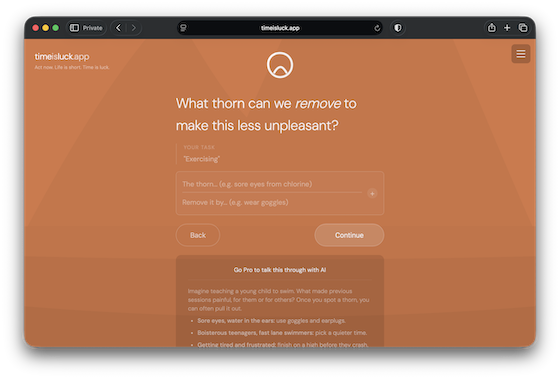
The basal ganglia evaluates every potential action based on expected emotional outcome. By reframing tasks and adjusting what we anticipate feeling, we can shift the brain's go/no-go decision in our favor.
Implementation Intentions
Specific "when-then" planning dramatically increases follow-through compared to vague intentions.
Motivational Interviewing
Our method-trained AI coach uses reflective questioning to help you discover your own reasons for change, rather than telling you what to do.
But this isn't therapy. You don't need to understand any of the "psychology stuff". It's a practical tool, that uses plain English, to help you do more of what matters to you.
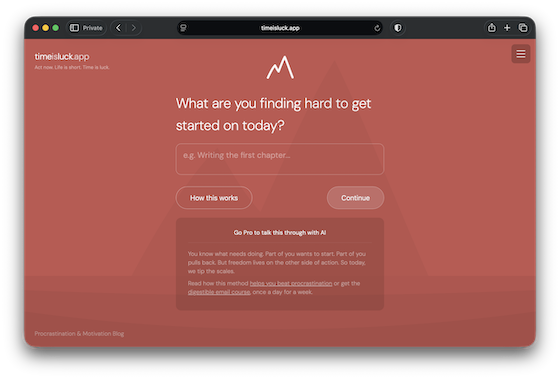
You know what needs doing. Part of you wants to start. Part of you pulls back. But freedom lives on the other side of action. So today, we tip the scales.
What is this?
This is the simplest, most reliable way to get started, and follow through, on the things that matter most to you.
Who is this for?
People with ambition and drive who want to push through resistance and expand their current limits.

You're not broken
There is a task, right now, that you want to complete, but you can't get yourself to start. Maybe there's more than one. That isn't a character flaw, and it isn't laziness. It's two different parts of your brain disagreeing. The part that makes plans and sets goals is completely separate from the part that decides whether you take action.

The Gatekeeper
Before anything happens, a small structure deep in your brain called the basal ganglia, checks one thing. How is this going to feel? If your past experience of similar actions was pleasurable, exciting, or rewarding, you act with a sense of motivation. If your past experience was painful, boring, or overwhelming, it blocks your action. Not as punishment, as protection.

Evidence not reason
You can't reason with a blocked gatekeeper, but you can give it new evidence in the only language it understands. That's what Time Is Luck does: four strategies, run in sequence, in about four minutes. A few short questions, a tiny step planner and a timer. Together they help tip the scales towards action.

Confidence is earned
Practice the method over time and something deeper takes hold. You begin to live with the satisfaction of knowing your decisions become your actions. Your future self becomes a partner you can plan with. You promise yourself something on Monday and find, by Friday, that the promise was kept.
Three simple tools to improve your action taking…
1. What are you finding hard to get started on?
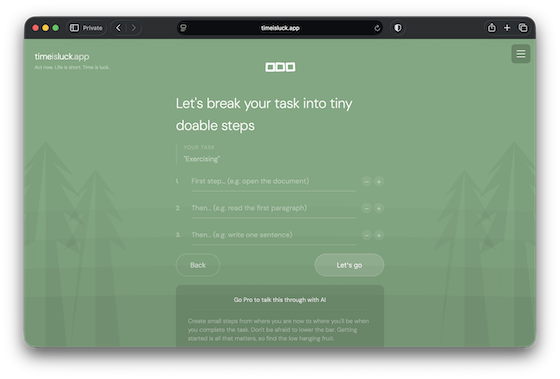
The core of the app. When you know what you want to do but find yourself resisting, follow this path. A short series of questions shifts how your brain sizes up the task and tips you toward starting. Take your time at first; mastering this method is like developing a super power. Use Hint for examples and the in app Coach to talk a question through. Then split the work into tiny steps. Starting is most of the battle; each small win makes the next step easier.
2. Record what you got done today
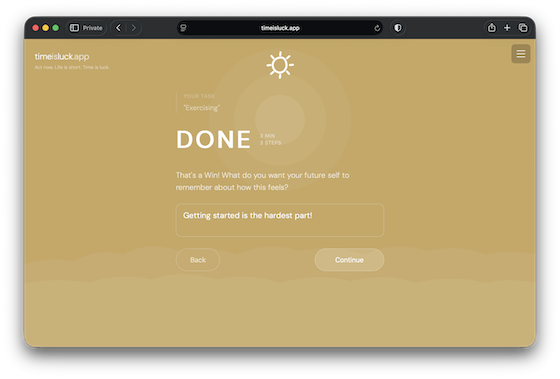
When we take action on difficult tasks we're rewarded with a shot of satisfaction, pride or relief. Those rewards are like money in the bank. This simple tool is where you can record those actions, however small, and check your balance when you need a reminder in the future. Use it daily and you change the baseline of your ability to act. Because you've proven time and again that taking action results in positive emotional outcomes more often than not.
3. Your action plan
Some days we just have to struggle through whatever is in front of us. Maybe it's a task we chose, maybe it's a task that was handed to us. This tool is here to make sure that at least some of the time we're thinking about and moving towards outcomes that have been consciously chosen by us.
This is where you create your action plan. Starting with what drives you. Not what's politically correct. What you are innately moved, motivated and inspired by. Freedom, power, significance, belonging, desire. You define what moves you. Then shape that drive into a goal, an achievable outcome. Then define the tasks required to achieve it. The skills, steps, actions it will take to make it real. Define as many as you want, across different aspects of your life. Check in regularly, keep score, ask yourself: how many actions did I take today to move me closer to what really matters to me?